

This article is the seventh in a series on modern folk beliefs. In the series so far:
“Immigration built Britain”
Every society has its folk beliefs: sayings and stories about the world that are widely held yet not grounded in fact. Traditionally, these were things like a maxim about health or wealth from your grandmother, or an old proverb of forgotten origin. But from the mid 20th century, ideas originating from academia or political activism, transmitted by mass media and mass education, came to be ever more influential in determining mainstream culture. This has given rise to what I have come to think of as modern folk beliefs; simplistic, muddled and often moralistic versions of the original ideas that have become widely held among large segments of society.
The folk belief that is the subject of this article holds that immigration is a central theme of British history and a core aspect of Britain’s identity. It further holds that immigration is always a positive story, responsible in large part for the good things about the country. You can see it in recent statements from various politicians, such as Zack Polanski’s “Migration is our DNA as a country” [sic], or Diane Abbott’s “Immigrants built this land”. Various journalists, public officials and activists now claim things like “immigrants built Britain”, “Wales and Britain is the great country it is because of centuries of immigration”, or “we are a country that’s been built on immigration”. In my experience, the belief has also filtered down significantly into the general population.
There’s a trivially true version of the claim, in that there has always been some immigration to Britain, and that these immigrants have made various contributions to national life. But it’s generally made in a far stronger way – not just that some immigrants made contributions, but that immigration was central and foundational. In this article I will interpret the claim in its stronger form, as I think it’s pretty clear that that’s how its advocates intend it.
This article will go over the history of settlement in and immigration to Britain, highlighting the aspects which are the focus of the mythmaking, before going into the origins and nature of the belief.
The mythmaking begins with the attempt to force the early settlement of Britain into an ‘immigration’ conceptual box. Stewart Lee’s well-known comedy sketch from 2013 offers a good example, mocking the idea that there is anything unusual about current immigration, which has always consisted of nothing more than newcomers bringing useful new goods and services to a benighted and prejudiced native population. In this conception the ‘immigrant’ beaker folk in 2000 BC brought, naturally, their beakers, while the Anglo-Saxons brought their jewellery, ship burials and epic poetry.
In reality these groups were not immigrants joining an existing society but settlers establishing a new one, a process which was catastrophic for the existing population. The arrival of the beaker folk led to the replacement of 90% of Britain’s gene pool, a process which I imagine involved something rather more traumatic than the exchange of beakers, while the negative impact of the settlement of the Anglo-Saxons on the Britons hardly needs to be spelled out. Stewart Lee would probably respond to this in the vein of “it’s just a joke mate”, yet it’s now common to hear people genuinely equate this early settlement with modern immigration.
Once we get into more recent centuries, which saw something like immigration in the contemporary sense, it still remained on a far too small a scale to have possibly ‘built Britain’. The largest and best-known example prior to the 19th century was that of the Huguenots, around 50,000 of whom came in the last decades of the 17th century, but making up only around 1% of the overall population. In giving sanctuary only to those who shared the dominant religion, it was also entirely unlike our present asylum policy. The closest analogy to Huguenot migration today is probably Trump’s offer of asylum to white South Africans.
Irish immigration came in the 19th century, with there being around 800,000 Irish-born people (3.5% of the population) recorded at the peak in the 1861 census. Considering that Ireland was part of the United Kingdom at the time, whether this truly counts as immigration is debatable, but I’ll allow it. Here we can see how much the left has changed tune on this issue. Both Marx and Engels1 were very clear that Irish immigration into British industrial towns was in the interests of the capitalists, and that its impact was to depress wages and degrade the condition of the native working class. This was the mainstream view on the left well into the twentieth century, but has now disappeared from British left-wing politics. In the US, Bernie Sanders advanced this position in 2015, to the vociferous opposition of the less traditional left. Then, in the late 19th and early 20th century around 300,000 East-European Jews came to Britain, coming to make up around 0.7% of the total population prior to the first world war.
These were the largest groups to come in this period, various others came in small numbers, including various Europeans such as Dutch or Italians, and a very few from Asia or Africa, mostly seamen who settled in port cities. During these centuries, the foreign-born never made up more than a few percentage points of the British population, which was in fact expanding massively through natural increase, while sending millions to settle abroad.
After the second world war, immigration started to become more significant, and the core focus of today’s mythmaking is on the non-white immigrants who arrived during these decades. Most prominent in the narrative is, of course, the ‘Windrush generation’ from the Caribbean, who, Kier Starmer claimed last year, “laid the foundations for modern Britain.” We even have a National Windrush Monument at Waterloo station, including the inscription “You Called ... and We Came”, despite the fact that the Caribbean passengers were not called for and that the government of the day was alarmed at their arrival. In fact, in another example of how much the left has changed, it was Labour MPs who wrote to Clement Attlee urging stronger immigration control.
What the inscription is drawing upon is the subsequent, direct recruitment of people from the Caribbean to work in organisations like London transport and the NHS. The NHS roles are the most emphasised, in order to try and link immigration to that other modern myth of British life.2 This role was real, but the degree to which it is representative of the wider story has been exaggerated. By 1965 3,000 to 5,000 Jamaican women were working as NHS nurses, 2% of the total number of nursing staff. If we add other Caribbean countries it’s likely the numbers would be bumped up a bit, but Jamaica was the majority source. By this time there were 200,000 to 300,000 Caribbean-born people in Britain3, making the proportion working in the NHS no more than 3% of their total numbers.
Considering that we are told that this immigration laid the foundations for modern Britain, it’s legitimate to ask questions about the negatives too. Black Caribbeans became overrepresented in street crime from the 1970s, and by 1988, black people, the vast majority of Caribbean origin, made up 10% of the prison population, despite still only being 1% of the total population, an overrepresentation that continues to this day. The standard left-wing explanation for this is, of course, ‘racism’, despite no other non-white group reaching anything like this level. A similar story can be seen in social housing, in which Black Caribbeans were twice as likely to live as the general population by 19914; today they remain the group that is the most dependent on it, at 48% of households. Is this best described as building Britain, or is it living in a country that was already built?
The same dynamic can be seen more generally. Immigrants overall did make up significant proportions of NHS staff, most prominently making up around a quarter of NHS doctors in the early 1970s, and a significant but smaller proportion of nurses. There were perhaps 50-100,000 foreign-born workers in the NHS by the late 1960s, which is a significant amount, but the 1971 census listed 3,190,300 foreign-born people in Britain, making the proportion working in the NHS no more than 3% of the total.
And again, we’re entitled to look at the negatives. Many immigrants in this period came to work in Britain’s struggling manufacturing industries, most famously, from places like Mirpur and elsewhere in Pakistan to Bradford and other cities. Doubtless the manufacturers appreciated this influx of cheap labour, but it did nothing to stop industrial decline, while its consequences included the grooming gangs, the 7/7 bombings, and most recently the rise of sectarian politics in multiple towns and cities across Britain. Some immigrants helped to build Britain, but others damaged and degraded Britain too.
Primary immigration was heavily restricted by the mid 1970s, by the Immigration Act 1971 for example, although immigration continued, often via family based chain migration from South Asia, despite attempts to stop this including the ‘primary purpose’ rule, introduced in 1980. Nevertheless, as of the late 90s, political sociologist Christian Joppke could still describe Britain as “the Western world’s foremost ‘would-be zero immigration country’, displaying an exceptionally strong and unrelenting hand in bringing immigration down to the ‘inescapable minimum”.5
However, just as Joppke was publishing, things were changing. As the graph below demonstrates, the real boom in Britain’s foreign-born population happened after the accession of the New Labour government in 1997. And looking only at the foreign-born understates the dramatic impact of the change. Previous waves of European immigrants mostly assimilated into the ‘White British’ population within a few generations. While this process continues today for some groups, no one observing the third-generation in places like Tower Hamlets or Oldham could possible think that this process is happening here. While the British-born population is now down to around 80%, the White British population overall is now around 73%, the state school-aged proportion is around 63% and the proportion of births is not much above 50%. All these statistics were above 90% as late as the 1990s.
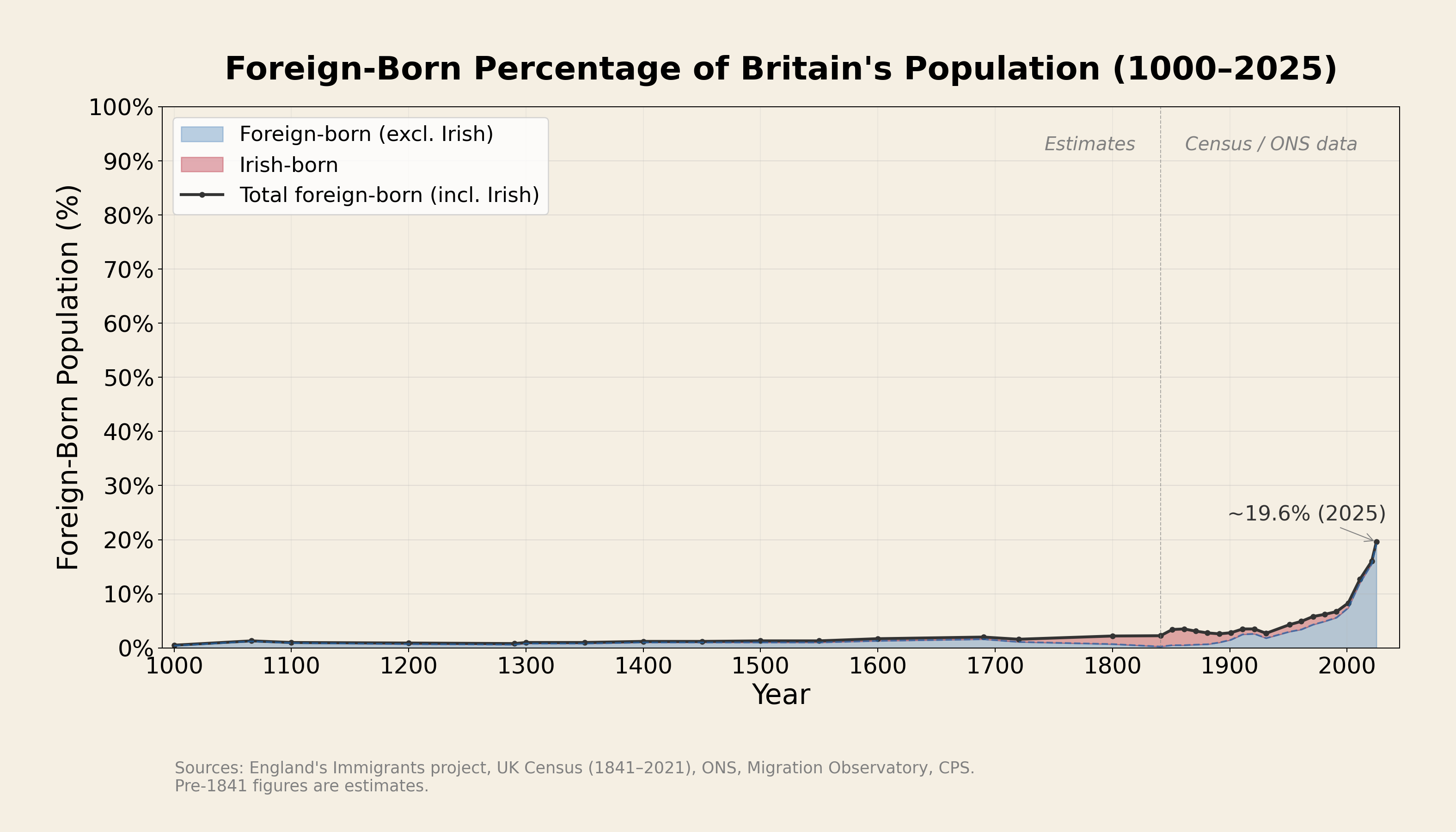
This period of accelerated immigration and demographic change was, not uncoincidentally, the period in which the claim that immigration had always defined Britain started to become common.6 In a Civitas report from 2007, David Conway identified the earliest example as the 1996 publication from the Commission for Racial Equality called Roots of the Future: Ethnic Diversity in the Making of Britain, in which it was claimed that “everyone who lives in Britain today is either an immigrant or the descendant of an immigrant.” New Labour Minister for Asylum and Immigration Barbara Roche was an early adopter of this narrative, claiming in 2000 and 2001 that Britain was a nation of immigrants, and in 2004 that “immigration is firmly entwined with any notion of what it is to be British”. Perhaps surprisingly for the time, though not if you look at his more recent statements, Tory leader William Hague was another, describing Britain as “a nation of immigrants” in 2000. From these little acorns, mighty oaks have now grown, and the idea is now widespread.
On an instrumental level, many people who make these statements are trying to create a new national story that fits with the largely unwanted demographic transformation their ideology has wrought. But I think that there is a wider story here, that they want to be a nation of immigrants because they think that this template is what it is to be a modern nation.
I have written previously about the importance of national templates. In the medieval era, monarchs sought to be the ‘Most Christian King’ among their peers; which was replaced by the ideal of the nation state in the modern era. While, as I wrote about in a previous article in this series, the idea that this era saw the ‘creation’ of the idea of the nation is a misconception, it’s definitely true that it saw the national principle rise to become the preeminent template for what a country should be.
Places that first established the template fit it better than those that came later. For example, by the 19th century, somewhere like Britain or France had a long history of national statehood and a national literary culture to draw on. This was less true in less developed parts of Europe where multi-ethnic empires still held sway; the Estonian national epic Kalevipoeg, for example, was consciously created as such in the 19th century out of existing oral folklore. In the last ‘nation states’ to be established, such as the post-colonial states of Africa, there was almost no connection between the reality on the ground and the official national form of the state, with predictable consequences.
If the most influential template for the age of nationalism was established by France, the one for the age of diversity and immigration came from the postwar United States. This template has two strands; one is the idea of being a nation of immigrants, the other is the centrality of black people in symbolising the nation’s historic sins and its contemporary redemption. The symbolic importance of black people is a topic which I have discussed previously. I won’t go into it more here, but it is likely a factor in why it was ‘the Windrush generation’ who have become celebrated in particular.
Both these conceptions make a lot more sense in the American context than elsewhere, yet even in the American case there was a large element of construction. As I described in The Rebirth of Anglo-America?, the dominant US self-conception only shifted to ‘a nation of immigrants’ from the 1960s onwards, in large part due to conscious political effort (see the history behind JFK’s 1958 book of that name). Previously, American identity had been defined to various degrees by Anglo-Saxonism, political liberty, and the experience of the frontier. Subsequently, much of this history was folded in under ‘immigration’, best exemplified in the Statue of Liberty’s transformation in the popular consciousness from a symbol of political freedom into one of immigration, calling out to the huddled masses. And the nation of immigrants narrative is not uncontested even today; the two Trump administrations have seen efforts to revive an older conception, such as removing the phrase ‘nation of immigrants’ from the mission statement of the United States Citizenship and Immigration Services, and promoting images of the frontier and traditional Americana.
In Britain, and in other European countries, the model makes far less sense. Despite the numbers of immigrants and their descendants being unprecedentedly high now, Britain developed its national identity over centuries of minimal immigration. In the American context it was possible, though historically awkward, to fit the early settlers into the ‘immigrant’ mold, but it isn’t really for Britain. And even in America, the ‘nation of immigrants’ narrative rose to dominance only after a 40 year mass immigration pause consequent on the Immigration Act of 1924, strong assimilatory pressures, and with immigrants who were physically similar to the native population, and, on a global scale, relatively culturally similar too.
An additional problem with applying the American template is that America’s shift to becoming a nation of immigrants came during a time of continued strong population growth among the original Anglo-settler population, and the national rise to world power. Immigration therefore could be seen as part of this story of progress and growth. Britain’s era of mass immigration by contrast has happened during a period of national, and native population decline, which inevitably gives a different cast to the process.
British political leaders are desperately trying to fit the unprecedented demographic change of today into the ‘nation of immigrants’ paradigm established by a 1960s America in very different circumstances. Immigration didn’t build Britain, but Britain is being transformed by immigration today, into something that has increasingly little connection to the nation that was built up over centuries. This is why the idea of the Yookay has such resonance; something is being built out of Britain, but it is something else. The folk belief’s advocates hope that as immigration continues to transform our demographics, reality will eventually catch up to the rhetoric. But the official template does not fit what is actually happening.
Related articles:
Liberal patriots and most Christian Kings

One of the curious things about the national pride, such as it is, of modern British left liberals, is that it has little to do with Britain as a real country with real history at all. Instead, this pride depends upon the extent to which Britain fulfils the tenets of liberalism, like how medieval monarchs sought to be the ‘most Christian King’ among the…
The process of yookay-ification

A version of this article was previously published in The Critic on the 11th June.
The rebirth of Anglo-America?

Recently I saw Ed West had identified an apparent rise in English-American identification in the US. The map triggering this discussion was unsourced but the one below from the US Census Bureau shows substantially the same story: in the 2020 census English was the largest white ancestry across much of the country, and the most common ancestry overall.
Folk Beliefs of the Upper Normie II: “Nations are Modern Creations”

This article is the second in a series on modern folk beliefs. In the series so far:
See the sections on the Irish in his ‘The Condition of the Working Class in England’
As a side note, the demand of the NHS for immigrant labour is a good example of why the idea that immigration happens due to the demands of capitalism is insufficient. Socialist institutions also demand immigrant labour because they do not pay market rate.
Estimated from numbers in p. 65 of Peach, C. (1986). “Patterns of Afro-Caribbean Migration and Settlement in Great Britain: 1945–1981”. In Brock, Colin (ed.). The Caribbean in Europe: Aspects of the West Indian Experience in Britain, France and the Netherlands. London: Frank Cass & Co.
See p. 1667 in Peach, C. (1998). South Asian and Caribbean ethnic minority housing choice in Britain. Urban studies, 35(10), 1657-1680.
See p. 100, in Joppke, C. (1999). Immigration and the nation-state: the United States, Germany, and Great Britain. Clarendon Press. Oxford University Press.
While the origins of the British people in various different waves of settlement had long been part of the national story, ideas like ‘immigration built Britain’ or ‘nation of immigrants’ are different because they emphasise immigration and diversity itself as a desirable thing, rather than something that happened long ago and led to a unified country.
Yep yookayaesthetics is one of the only things that honestly engages. I'm not blackpilled as I think the last 5 years has seen a lot of positive signs on the right. If nothing has changed in 10 years though then I will be.
This is really great.
I find myself despairing in the face of multiculturalist ideology. What can you even say to people who would cite immigration from within a radius less than the length of Great Britain as justification for immigration from the other side of the globe? No amount of crime or ethnic tension seems to dent their enthusiasm. They have all the unreasoned conviction of a cult.
I’m writing from Ireland, where the national broadcaster recently did one of those landmark, ‘story of the nation’ documentary series. There was minor controversy (but no more than that) when the producer and writer said, “We Irish were never homogeneous. Always hybrids, always mongrels”. What a coincidence that it should pop up right at the time that other Western countries are reimagining their pasts to accommodate mass migration. I wonder is this producer consciously engaged in propaganda or if she is just blissfully unaware of the ideological current that has swept her onto this topic.
The word mongrel would, of course, lose you your career if applied to any minority group. But, to be honest, I‘m sympathetic to her use of it. I’m a lifelong anti-nationalist in Ireland, railing against Anglophobia. The diversity of the Irish population is one of the arguments I would once have reached for. But now I find myself having to forge a path between Gaelic nationalists on one side and open-border progressives on the other (who, ironically, often overlap). One of the maddening things, therefore, about mass migration (the Irish population is now close to 25% foreign-born) is that it complicates how we talk about ourselves.