

A version of this article was originally published in The Critic on the 28th October.
The uproar over Sarah Pochin’s comments on the skewed representation of Britain’s demographics in its adverts continues. Keir Starmer called her comments “shocking racism and it’s the sort of thing that will tear our country apart”; a sentiment echoed by many other MPs and political figures. The offending statement in question was:
“[I]t drives me mad when I see adverts full of black people, full of Asian people, full of, you know, people that are basically anything other than white [...] well it doesn’t reflect our society”.
Pochin phrased things indelicately and somewhat hyperbolically. Nevertheless, her comments were more fair and accurate than those of her critics, which in their extreme disingenuousness offer a perfect example of how officially accepted opinion on matters of race works in this country.
Pochin was not complaining about non-white people being in adverts. She was complaining about them being disproportionately represented. We do have statistics on this question. A month ago Channel 4 put out a report titled Mirror on the Industry, containing statistics of the demographics of UK TV advertising. In 2024, Black people (4 per cent of the population) featured in 51 per cent of ads, 23 per cent with them in a lead role. South Asians (8 per cent of the population) featured in 17 per cent of ads, 6 per cent with them in a lead role. East Asians (1 per cent of the population) featured in 11 per cent of ads, with 2 per cent of lead roles, while mixed ethnicity people (3 per cent of the population) feature in 9 per cent of ads, with 4 per cent of lead roles.
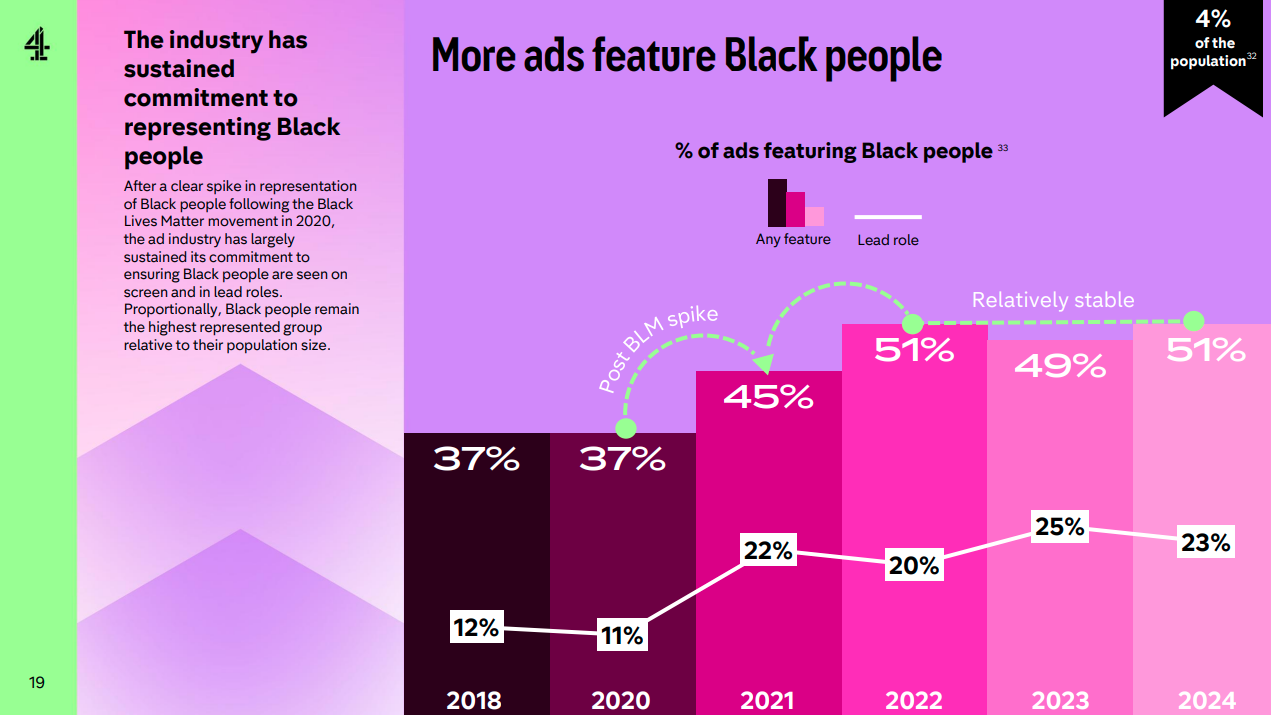
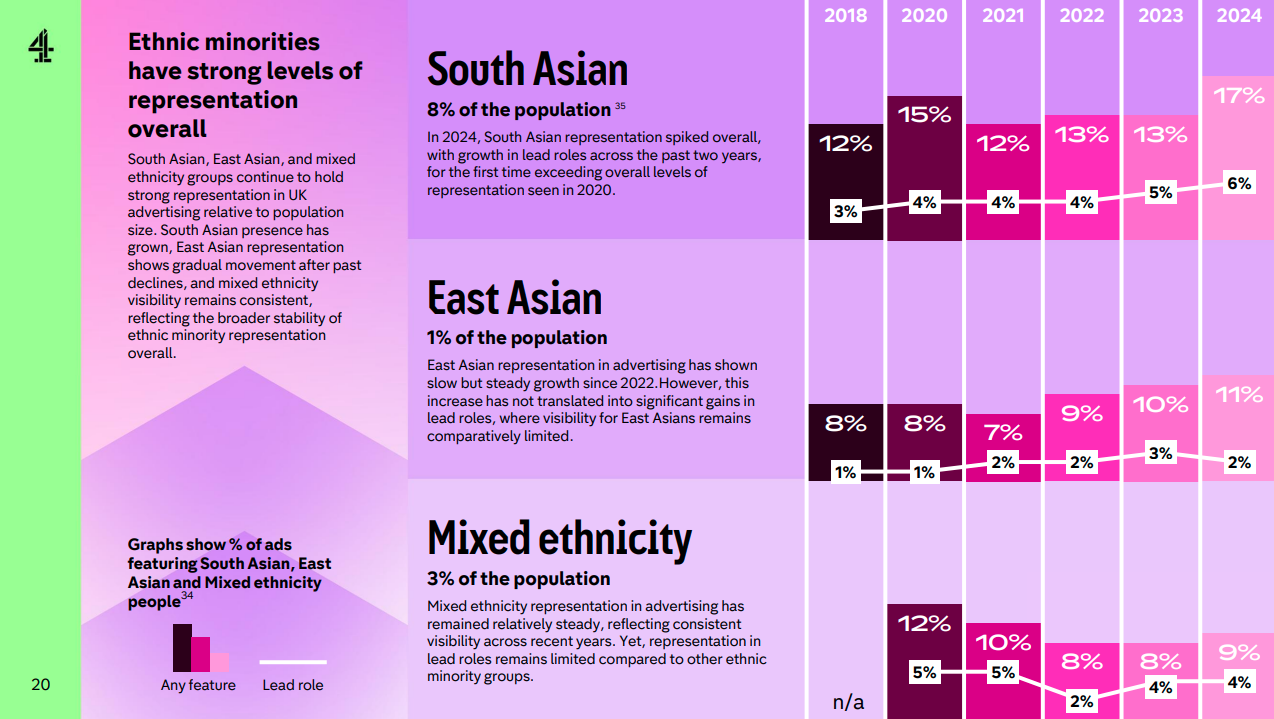
All these groups are hugely over-represented in the “% of ads featuring” stats, but this statistic is not the clearest one as “featuring” could mean various things, from a face in a crowd to a significant role. So if we take the “lead roles” statistic as the most significant one, then Pochin was correct about non-white over-representation in general, but only about black people in particular. South Asians are actually slightly underrepresented in lead roles, while the East Asian and mixed categories are over-represented proportionally, but still at a low level absolutely.
This sort of statistic is something that self-defined respectable voices refuse to discuss honestly. Channel 4 themselves in their press release that accompanied the report completely failed to mention it, instead focusing on the under-representation of pregnant women, LGBTQIA+ people, and the disabled. (A tangential point, but considering that we are told not to stereotype based on appearance, that trans women are women, and that not all disabilities are visible, complaining about visual under-representation of these characteristics is absurd).
The succession of MPs that lined up to excoriate Pochin displayed a similar level of disingenuousness. Predictably, many offered only platitudes that had nothing to do with the actual issue, such as a dictionary definition of racism, or claiming “the colour of someone’s skin” drove Pochin mad, or the importance of diversity on TV. Others went with the well-worn accusation that you’re weird for even noticing (doubtless they would be the first to notice if there were too many white people). None of them engaged with the substance of what Pochin was saying, and so for all the ways she failed to offer a sober and nuanced take, her opponents, in throwing around accusations of racism and refusing to even admit there is anything to see here, are far worse.
None of these reactions, of course, are that surprising given how taboos around race in our culture have developed over the last few decades. I think it is interesting, though, to look into exactly why things have developed as they have.
Diversity is blackness
Diversity has become a sacred value in our society, but the extreme overrepresentation of black people in particular is clearly not about literal “diversity”, as there are over twice as many South Asians as black people in Britain. The most bizarre example I have seen of this tendency was in adverts for ScotRail in 2024, whose homepage at the time featured three black or mixed black people, six white people, and no Asians, in a Scotland that was 93 per cent white, 3.9 per cent Asian, and 1.2 per cent black. So what’s going on?
Some people have claimed that this is due to British advertising agencies being based in London and reflecting what they see around them. I don’t think this is true though – London’s population is 14 per cent black, far more than the rest of the country, but it is even more Asian: 21 per cent.
Others, usually in the American context, cite studies showing that black people care more about seeing their own race in adverts than white people do, and so the advertisers are catering to this. I am sceptical of this explanation even in America, but in Britain, with black people making up such a tiny percentage of the market for the vast majority of products advertised, it certainly cannot explain things.
I think the real answer is less concrete than these explanations and has more to do with the broad ideas our culture has developed about what is to be celebrated and even sacralised. At the more prosaic level there is the prominence of blacks compared to other non-white groups in sports and entertainment, which will raise their “coolness levels” comparatively. But this is not the whole story: the other aspect is altogether weirder. Western countries have elevated diversity and anti-racism to sacred values since the 1960s, and black people have emerged as the totemic figures to represent these values because they have been deemed the ultimate oppressed group. Channel 4’s graph above demonstrates this by the post-BLM spike in black representation, from already high levels to even higher levels.
The dominant cultural influence of the US, with its larger and more established black population, is also crucial. Britain at least does have a black population, but I once came across an account of an Austrian writing on this topic who claimed that due to US influence there were more black than Turkish people in Austrian ads, despite there being barely any black people in the country but hundreds of thousands of Turks. I have heard similar accounts from Poland. But moving the explanation to the US doesn’t answer the question, it only shifts it, as the same dynamic is at play there too, where blacks (only 14% of the population) have an outsized presence in advertising and culture in general compared to say, Hispanics, who are a larger proportion (20%) of the population.
Advertisers are not consciously deciding to overrepresent black people in particular due to some commercial metric, they are, as advertisers always do, attempting to convey an image of desirability, aspiration, and in the broadest sense of what society deems as “good”, and to link it to their products. Diversity is seen as good, and in the somewhat inchoate thoughts of the advertising executives, black people are diversity.
What will be the effect of Sarah Pochin’s statements?
As we have seen, the official response to Pochin’s comments from the centre and left of the political spectrum has been obtuseness and outrage. But many voters will have been noticing these things for years and will instead be thinking some variation of “well she’s right though isn’t she, and I’m glad someone in politics finally said it”.
Someone previously responded to me on this question saying this topic needs nuanced comment, not venting on live TV in the manner of a simplified “boomer caricature”. Personally I would have much preferred it if sensible, competent people had been nuanced and sensible on issues of race and immigration over the last few decades. But they haven’t, and there’s little sign they are becoming so now. What we have instead is an asymmetrical multiculturalism where over-representation of non-white groups is either taken as natural or celebrated, while overrepresentation (or even accurate numerical representation) of white people is castigated. So if “boomer caricatures” are the only alternative, then sign me up.
You may also like:
The process of yookay-ification

A version of this article was previously published in The Critic on the 11th June.
Great piece.
I can say categorically that overrepresentation in ads was my gateway drug. Gradually, then suddenly, I became outraged that activists were given free rein to impose their fantasies on the public.
I would once have agreed with you about there being a better, more-responsible way for Pochin to address her grievance. But I now think that that expects too much. How often it happens that a left-wing grievance makes itself heard in some antisocial fashion before being picked up and sanitised by the establishment. In comparison, a phone-in radio programme is the height of propriety.
I watched Immigration: How British Politics Failed, the surprisingly candid BBC documentary, and was amazed to learn that in 2003 the BBC did a whole day of programming dedicated to immigration. Impossible to imagine today. If the establishment wants a responsible debate, it needs to provide that kind of platform for it.
Farage is a shrewd operator and I wonder if he has licensed Pochin to go out on a limb and say things that would cause a massive ruction if he said them, but throws red meat to people like me who might toy with the idea of joining Ben Habib's outfit (especially if it gained traction).