

I recently came across a work of anthropology which, more than anything else I’ve read, explains the context in which the predominantly Pakistani (and most notoriously, Mirpuri) grooming gangs developed in Britain. The work is Professor Alison Shaw’s 1980s fieldwork on the Pakistani community of Oxford, which she wrote up in A Pakistani Community in Britain (1988), and subsequently revised in Kinship and Continuity: Pakistani Families in Britain (2000). Like most academic books, it is absurdly expensive to buy, but the revised edition, which is the one I have, is available to download on Anna’s Archive.
Reading it brought home to me how rare it is to see high-quality social scientific investigation into the consequences of Britain’s experiment with mass, unselective immigration. We are only now really coming to terms with the reality of the grooming gangs, perhaps better termed mass rape and abuse gangs, and it is clear that a large contributor to how they were – and likely still are – allowed to operate with relative impunity was an aversion to truly appreciating what was going on from an ethnic perspective.
The ethnic component to the grooming gangs
Speaking simplistically we could divide incidents of rape into two categories, ‘intra-community’ and ‘extra-community’. The ‘intra-community’ type is individual men committing a crime that they would expect to be punished for, by their community, if it was discovered. The second is that which takes place between communities, i.e. what invading armies have done throughout history, from the rape and pillage of medieval warfare, to more modern examples like the rape of Berlin in 1945, the mass rape by Pakistani soldiers during the Bangladesh liberation war of 1971, or contemporary atrocities in Sudan. This type is committed by a group, to a group, and is more normalised by its perpetrators, who have little expectation of punishment by their own group.
The reason that the left in Britain failed to grasp, or deliberately misunderstood, the true nature of the grooming gangs is that they tried to interpret them purely as examples of the first category, when to a significant extent they are examples of the second. When talking about causes, efforts are made to keep focus on comfortable home-turf topics like classism, the underfunding of public services, and generalised male violence and misogyny. These things were undoubtedly important: it’s clear from reading the accounts that both the police and social workers tended to view the girls as problem children who there was no point in helping, as they had made their own choices to end up where they were.
You could also go some way to explain the fact that the perpetrators were predominantly Pakistani, and the victims white English, on the grounds that social groups in the affected towns tended to cluster by ethnicity, and that vulnerable girls living in chaotic situations tended to be English. Additionally you could point to the fact that a good number of those convicted were already involved in serious crime and were thus not exactly representative members of their community.
However, it’s also true that the crimes had many characteristics of ‘extra-community’ rape. Many of those convicted were ordinary men working as takeaway owners and taxi drivers, and this profile is likely more characteristic of the more numerous, peripheral perpetrators who abused girls when given the opportunity by the core members but who were not directly involved in controlling and pimping. Going by the many accounts of victims being trafficked around the country and being abused by hundreds of ‘Asian men’, these perpetrators, most of whom escaped justice, must number in the thousands. Another aspect of ‘extra-community rape’ was the common pattern of a girl initially being raped by one or two men, who would then call a group of others to come and join them to continue the abuse.
Most explicitly, you can see in many accounts how the girls’ whiteness was clearly relevant in their abuse. A victim in Rotherham was called a “white slag” and a “white cunt” as she was beaten, while another one in the town was told “that is what white girls were for.” Another said her abusers “spoke about ‘white girls’ as people they could use, saying they needed to keep Pakistani girls ‘pure’”. Another Rotherham victim was called a “white bitch” and that Asian women did not perform oral sex as it was against their religion. A victim in Keighley was called a “little white slag”, one in Rochdale was also called a “white slag” as she was punched in the face, while a victim in Oxford was told to recruit more girls, who also had to be white.
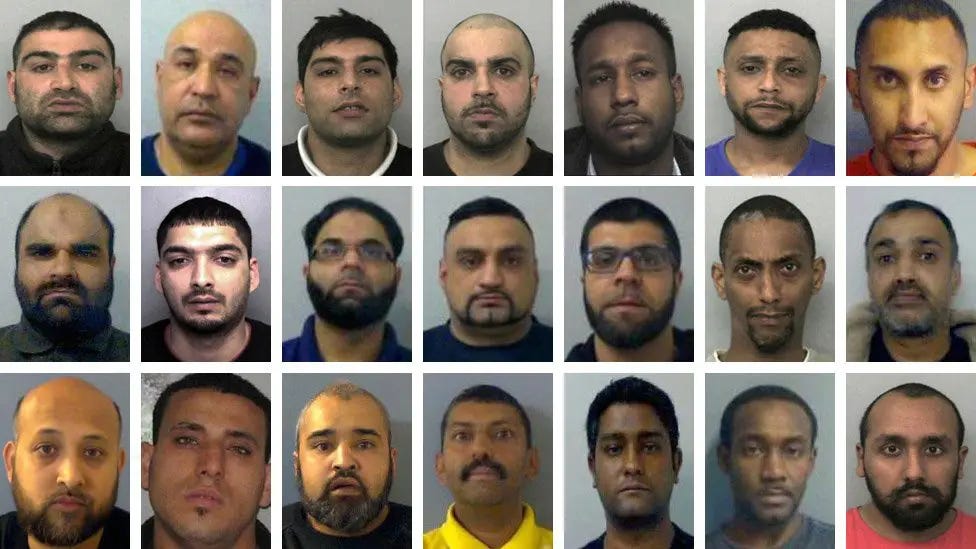
The anthropological context
The reason I found Alison Shaw’s book so illuminating is that it relays many examples in the population she was studying of an attitude that it is natural for men to take sexual advantage of women who are outside, uncovered, and unprotected by male relatives, and that if this happens, it is the woman’s fault. Holding these attitudes is not the same thing as actually committing rape, but it’s hard to avoid noticing how closely they fit with the accounts of how the grooming gangs operated and what the men thought of the girls they were abusing.
One mosque committee member used this image to explain the ideals of purdah:
“If you have something valuable, you keep it safe. If you have a diamond you lock it in a case. You don’t leave it for anyone to take. A woman is like a diamond. She is precious. You should keep her inside the four walls of your house. She should look after the house and children, and you look after her. Inside the house, she is in charge. My place is outside”.
For many people across the generations, the experience of living in Britain has reinforced aspects of the traditional view of the relationship between men and women. This is because images of women in the west provide constant reminders of the contrasting Islamic ideal. A corollary of the idea that a woman should be protected is that a woman who is ‘outside’, among men, unprotected, is ‘free for anyone to take’. Western women in particular appear to break all the rules of purdah. ‘They are regarded as sexually promiscuous, moving freely from one man to another, behaving and dressing in order to provoke men. A woman out alone is in effect ‘asking’ for sexual relations with a man. Rape, young and older men have insisted, is always the woman’s fault, because it is the ‘natural’ result of a woman dressing provocatively and being out alone. In this view, western women are simultaneously exciting and despised for having no sense of shame and being ‘used by more than one man; like prostitutes’. As the man quoted above put it:
“Women are exploited in English society. They are like toys for men to play with. They are cheap. Women are out on the streets, in shops, on the television. They work like slaves for a pittance in factories, in shops and as cleaners. There’s no respect for them.”
His wife then showed me what she thought of English women by pulling her shalwar tight across her buttocks, loosening her hair and swaying her hips, in imitation of how an English woman attracts a man.” (p. 167).
The role of protective male relatives is key: it was their potential objection to sexual activity which mattered most. One man, in response to her asking him why it was not acceptable for a female relative of his to date, but it was acceptable for him to date English girls, said:
“[T]hat’s different. The difference is, English people don’t care. The girls don’t mind; you tell them you can’t marry them, you’re just passing your time, and they don’t bother. They’re just passing their time too. If their brothers or fathers got angry, we would understand, but they don’t bother. Mostly, they are not even living in the same place. How can you respect men like that? They just say it’s the girl’s choice, it’s her life, and that’s what the girls say too.” (p. 173)
Shaw’s book is generally quite unflinching about the negative aspects of what she sees, but I did notice one difference between the original 1988 and revised 2000 edition that shows that she too may be shying away from reporting some of the most controversial statements. I don’t have the original edition, but this site reproduces some excerpts. In it we have a pretty clear statement from a recently arrived Pakistani man that rape of unprotected women is to be expected from ‘real men’:
“Many Pakistanis hold a low opinion of western social and sexual mores and particularly of the position of women in western society. English women are seen to break all the rules governing sexual morality. The western system, it is thought, permits free sexual relations and allows, even encourages, women to dress revealingly and to provoke men. One Pakistani man who had recently arrived in England, commented on seeing a number of female University students sunbathing that the male undergraduates who were passing by could not be real men or else they would have thrown themselves on the women. Pakistani women often cite Britain’s high divorce rate and the increasing proportion of illegitimate births as evidence of the low moral standards of the west.” (p. 140)
In the updated edition the inflammatory quote from the Pakistani man has been removed:
“Many Pakistanis hold a low opinion of western social and sexual morality and particularly of the position of women in western society. They consider that the western system permits free sexual relations and even encourages women to dress revealingly and to provoke men. They often cite Britain’s high divorce rate and the increasing proportion of illegitimate births as evidence of the low moral standards of the west.” (p. 266).
I’d encourage people to get the book for themselves. Shaw is by no means hostile to the people she studies, but she is clear-eyed. Aside from the grooming gangs, it provides context on other characteristics of the Pakistani community that are useful to understand its interactions with wider British society. I won’t reproduce those here, but I tweeted about some of them recently. Examples are things like the sex-segregated physical layout of Pakistani houses, and how this was replicated in Britain, how clannish, extended family communities can exploit individualist welfare states, why the biradari social structure makes sense in Pakistan and how it persisted in Britain, and how immigration to Britain was always a community effort. These are all examples of something I have written previously on: our failure to appreciate how particular Western family structure is compared to that which many immigrant groups come from.
The failure of social science
When I was reading the book I kept thinking “this should have been required reading for the police when evidence of the grooming gangs started to become available”. But of course, the opposite was true, as Chris Bayliss notes in his excellent article on this topic (which also has a good background on Mirpur and its moral systems):
“[T]here was effectively zero cultural or anthropological interest in the Asian communities that had settled in England either from academia or from government. This was the era of the Macpherson Report, and memories of intimidation by the National Front were recent, which there was a sense that the police hadn’t done enough to stop”.
A few exceptions notwithstanding, Shaw’s book is, in my experience, not representative of anthropology or sociology in general. Instead, these disciplines hold that structural forces determine things, and they share an unexamined assumption with much left-wing activism that non-white groups cannot really possess any negative characteristics. Thus something like the idea of ‘Muslim grooming gangs’ can only ever be a ‘trope’ or narrative that must be challenged. Any genuine understanding of how society functions and how ethnic groups differ from one another is thus prevented, making these disciplines increasingly useless for understanding our society. As I’ve written about before, what social science should really be is systematised ‘noticing’, but it is often nothing more than thinly disguised activism.
If academia is the supply-side, then the demand-side of government is even worse. As Bayliss described in his article, over the last few decades, half-understood anti-racist assumptions have become ingrained in the organs of the British state, and the saga of the grooming gangs has provided many examples of where a frank assessment of what was going on was inhibited by fears about racism and stereotyping Asian men. This squeamishness was well-known to the abusers themselves, who took full advantage of it. A care home manager, interviewed in the 2003 documentary Edge of The City, told the interviewer that the stock answer men waiting outside care homes would give to police was “you would not do this if I was white”. The abusers would tell girls not to tell their parents what was going on as they were “bound to be racist”.
My overwhelming frustration with all this is that a huge amount of harm could have been prevented had our society not gone down this bizarre path of refusing to notice any patterns that would paint a non-white group in a negative light. Examples are not limited to grooming gangs. Yesterday it was revealed that triple-killer Valdo Calocane had been released after “the team of professionals considered the research evidence that shows over-representation of young black males in detention”, while it was revealed in an inquiry in 2020 that a security guard did not approach the Manchester arena bomber before his attack in 2017 for fear of being racist. There are many more examples, see my article on ‘the war on noticing’ for them.
Political figures have recently started saying that the era of mass migration is coming to an end. But to deal with the situation this era has produced, these sorts of wilful, harmful denials of reality need to end too.
Related articles

Modern folk beliefs V: “Your ancestors had kids in their teens”

This article is the fifth in a series on modern folk beliefs. In the series so far:
Against the ‘ethnic food festival’ conception of culture

A particular view of ‘culture’ has become embedded in the collective midwit mind in recent years. I think of this as the ‘ethnic food festival’ understanding: culture as an exotic experience that you consume, normally deriving from some non-Western, or at least non-Anglo source. In this conception the only culture that Britain does possess is stolen fro…
Great work here, thanks
Steve Sailer, 2013:
https://www.takimag.com/article/the_real_threat_to_british_elites_steve_sailer/2/
"The pimps seemed convinced that since their victims’ families haven’t organized lethal vendettas against them like any honorable Pakistani family would, they must not have cared.
Moreover, since the English people hadn’t carried out mass communal violence, such as burning down Pakistani neighborhoods in the time-honored South Asian manner, clearly they didn’t mind.
And if the English government didn’t want Pakistanis to act Pakistani, they wouldn’t let them into England, now would they?
You have to admit the defendants have a point."
https://www.unz.com/isteve/how-muslims-are-kept-mostly-peaceful-in-india/
"Using this framework, I argue that minority Indian Muslims police themselves to prevent militancy within their community because they fear retaliatory indiscriminate mob violence, and this fear stems from a lack of confidence in the state to definitively protect Muslims from the mob."