

This article is the fourth in a series on modern folk beliefs. In the series so far:
“Climate change will lead to human extinction”
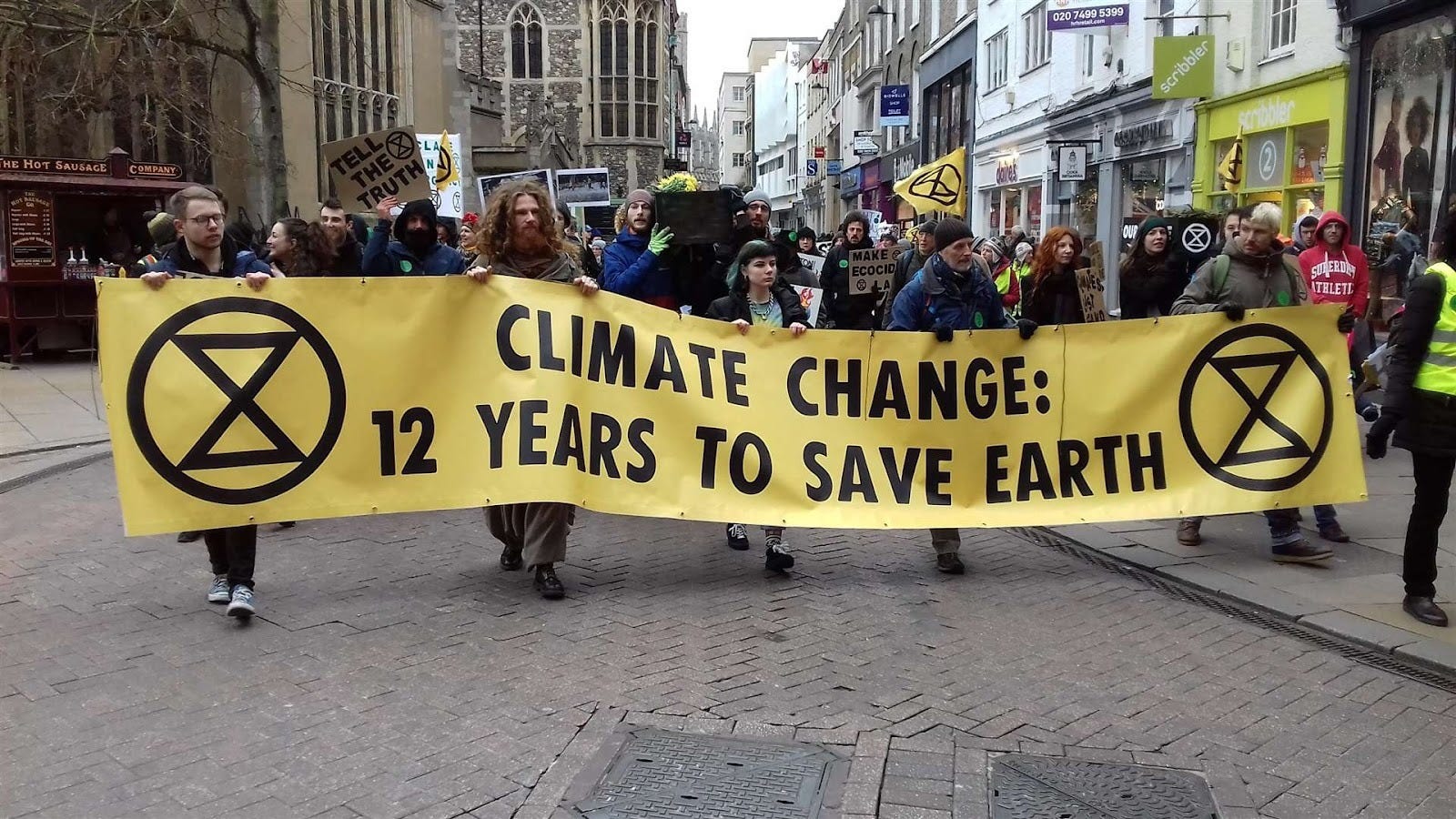
Every society has its folk beliefs: sayings and stories about the world that are widely held yet not grounded in fact. In the traditional conception, a folk belief was something like an old saying about health or wealth from your grandmother. But from the mid 20th century, ideas originating from academia or political activist movements, transmitted by mass media and mass education, came to be ever more influential in determining mainstream culture, replacing older sources such as the church. This process gave rise to what I have come to think of as modern folk beliefs: somewhat muddled, simplistic and often moralistic versions of these original ideas, widely held among certain segments of society. Today, due to the internet and social media, top-down cultural transmission is not the force it once was. However these sorts of modern folk beliefs remain prevalent, and some find even more fertile ground in the new media environment.
In my previous articles in this series I used the term ‘upper normie’ to describe those most likely to hold these folk beliefs. This describes someone who is intelligent enough and sufficiently plugged into highbrow discourse to have imbibed its ideas successfully, but who remains, despite their own self-conception, too conventionally minded to really question them. For this article though I’ve dispensed with this formulation, as going by the survey data, climate catastrophism is a much broader phenomenon.
“Climate change will lead to human extinction”
Climate change activism has been around since the 1980s but became particularly prominent in the 2000s and 2010s, peaking around 2019. That year Michael Shellenberger noted that the commentary on the issue had become increasingly apocalyptic. Alexandria Ocasio-Cortez said that young people like her believed the world was going to end in twelve years, while Greta Thunberg claimed that by 2030 we will set off a chain reaction that will lead to the end of civilisation. Joe Biden called it an “existential threat to humanity” in his final presidential debate of 2020, as did Kamala Harris. In Britain, these were the years of Extinction Rebellion: two of their activists, interviewed by Sky News in October 2019, claimed that ‘our children’s future is disappearing’ and that ‘billions of people are going to die’. As we’ll come to later, mainstream climate science never remotely supported these sorts of claims, though this had little effect on the activists.
This sort of rhetoric had a profound effect on a large swathe of the population, with many coming to believe that climate change would lead to the end of civilisation, or even of humanity itself, within their own lifetimes. A 2019 survey found that 54% of British adults thought that climate change threatened human extinction. In a 2021 survey over half of young people across the world reported that they thought humanity was doomed due to climate change. And in 2023 nearly two thirds of young Americans endorsed the statement ‘humanity is doomed’ and over half said climate change made them hesitant to have children. Readers will doubtless have encountered claims such as “well we’ll all be dead in thirty years anyway” or “I couldn’t bring children into a world that’s burning up from climate change”.
Over the last few years climate change has declined in salience, overshadowed by more immediately compelling movements like BLM in 2020 and the years after, and more recently by Gaza. Greta Thunberg herself diluted her focus from late 2023, adopting the keffiyeh in addition to her trademark woolly hat.
At the same time, the more rational class of activist has increasingly been calling for a proper contextualisation of the risks. 80,000 Hours, the Effective Altruist organisation which aims to guide people towards careers working on the world’s most pressing problems, published a ‘problem profile’ in 2022 asserting that while ‘climate change is going to significantly and negatively impact the world’, it is less pressing than higher priority areas like power seeking AI systems or factory farming. Climate change is currently only number nine on their list of the most pressing world problems. Similarly, a few weeks ago Bill Gates published an article saying that while climate change is serious, the doomsday view is incorrect, and that instead of focusing primarily on lowering emissions we should aim to improve human welfare more broadly.
This relative downgrading of concern is somewhat reflected in the public opinion survey data. The percentage of British people who are ‘very concerned’ about climate change dropped from 44% in autumn 2021 to 35% in spring 2025. There is no survey data from the last couple of years on the ‘humanity is doomed’ question, but going by the still-high level of concern in the surveys, and personal observations, I think it’s likely that substantial numbers still hold this view.
I went through a similar process of downgrading as I learnt more about climate change. Growing up during the years when concern about climate change was rising, I naturally became concerned by the catastrophic predictions and the calls for urgent action. I never had much respect for the ‘hard deniers’ who argued either that warming wasn’t happening or that it wasn’t caused by increased CO₂ emissions, and while there were figures around, such as Bjørn Lomborg, who argued for a position closer to the ‘rational activists’ I mentioned above, I felt them to be too politicised. So I started to read some of the official IPCC assessment reports that were generally held up as the consensus view of mainstream science. As I read these I began to realise that there was a vast discrepancy between what the reports said and the doomsday view that I heard all around me. What they said was that climate change was a serious issue that would cause various negative impacts, but nothing in them supported the idea of humanity’s imminent doom.
80,000 Hours’ position, or Bill Gates’s one, provide good overviews of the real risk from climate change. For a more comprehensive account, see this report on existential risks from climate change (shorter summaries here or here). Or indeed, just read the official IPCC reports. The key points are that the projected level of warming is likely to be harmful but far from existential, and that average living standards will probably continue to rise due to continued economic growth – despite climate change. Furthermore, the efforts to tackle climate change enacted so far have had a meaningful effect on projected future warming, making the worst outcomes even less likely. You could try and steelman the 2010s’ activists and say that the projections were more dire in these years than they are now, but the ‘extinction’ scenario was never one that mainstream science predicted.
How did climate activism stray so far from climate science?
So how did climate catastrophism become such an entrenched belief among a large swathe of society, when even mainstream climate science doesn’t support it? As far as the supply side goes, i.e. the deliberate strategies of the activists, the simplest explanation is that they recognised, partly consciously and partly unconsciously, that the science is dry and remote, and the most negative predicted consequences of climate change are uncertain and relatively far in the future. In many cases they are also outweighed by economic development. They knew therefore that simply relaying the science was insufficient to get people motivated enough to support political action. Thus we get, as in the Extinction Rebellion clip linked to above, activists promulgating to the public predictions like ‘billions will die’ if we do not take drastic action.
To the extent that this strategy was deliberate, you could put it under the category of ‘highbrow disinformation’ (also covered well here by Dan Williams) – misleading ideas promulgated supposedly for the greater good. But of course, watching the way activists talk, as in the Extinction Rebellion clip above, it seems that they seemed to believe these doomsday ideas themselves even more strongly than the public came to. This leads us to the demand side: why did so many people come to believe the doomsday view?
One reason seems likely to be human tendencies towards sacralisation and eschatology. I follow Jonathan Haidt in observing that purity/sanctity is a key human moral foundation, and that with the decline of religion people must find other outlets for this urge. It’s clear from observing the rhetoric of climate activists that they are seeking a sacred cause to dedicate themselves to, and found it in the environment and the idea of the planet. If the effects of climate change are interpreted as the planet ‘dying’ then this of course has a finality to it that the actual scientific projections do not. Once you sacralise something and link it to the end of the world, you remove it from cost/benefit calculations, and from considerations about tradeoffs. Therefore arguments such as those of Bill Gates above, that economic development in many cases has a greater effect on human wellbeing than climate change, are felt to be almost sacreligious, as exemplified by this Slate response entitled ‘Respectfully, Bill Gates Should Shut Up’.
People who hold the doomsday view of climate change also share the negative attitude to economic development that is widespread in Britain and Europe, and to a lesser but still significant extent in the US. This attitude views economic growth as irrelevant or even harmful, so the idea that we can actually successfully mitigate the harms of climate change is anathema. As Bill Gates noted, the number of global heat deaths has actually been decreasing for some time, largely because more people can afford air conditioners (while there are actually ten times as many deaths from extreme cold). In fact, people continue to flock to places that would be practically unlivable without air conditioning in summer, such as Phoenix or Dubai.
Similarly, natural disaster deaths have fallen 90% in the past century because of things like better warning systems and more resilient buildings. Considering that the actual scientific projections are not, contrary to the doomsday view, ones of extreme and sudden change, it seems highly likely that differences in economic development will continue to be more significant than climate change, however significant that may be absolutely. The economic development of Bangladesh over the last twenty years illustrates this point. When I was at school in the early 2000s, Bangladesh was held up as a perennially poverty-stricken place, beset by natural disasters, imminently to be inundated by climate change-caused rising sea levels. In fact this was exactly the period in which Bangladesh’s economy began to take off: its GDP has roughly quintupled between 2005 to 2025, in which time it has become far more resilient to natural disasters like cyclones.
Another aspect behind the doomsday view of climate change is the totalising mindset of this sort of activism: seeing the fight against climate change as just one part of a wider struggle against capitalism, imperialism, Zionism etc. If the world must be completely revolutionised for us to solve climate change, then more tractable solutions are discounted, or in some cases, such as nuclear energy, actively fought against. Climate change can simply be folded into the omnicause – complete with anticapitalism, degrowth and climate reparations – without thinking too much about the details. Hence why the priorities of Green political parties are so detached from actually tackling climate change.
Finally, there is the question of how seriously to take ‘beliefs’ in humanity’s imminent extinction. It is only possible for large numbers to hold this view because for most it is little more than vibes and rhetoric, or at best an inchoate sense of calamity mixed in with other things (as in “I can’t have kids because of climate change”). I always somewhat admired environmental activist George Monbiot, despite his politics, for practicing what he preaches. He froze in his house rather than use his wood-burning stoves which he had previously installed at great expense, after learning that they were actually bad for the environment. He gave up flying after concluding that most planes should be grounded, and he came out in support of nuclear power, after previously being strongly against it, recognising how necessary it would be to achieving his environmental goals. Monbiot, at least, honestly recognises the sacrifices that would be needed, as do some of the more dedicated activists, but these numbers do not approach the half of the population purporting to hold the view, who continue to live as normal.
The future of climate change and climate catastrophism
Over this century, the world will continue to warm, and this will cause negative effects, but the most pressing global issues will continue to be more immediate ones like immigration and demographic change, warfare and the changes brought about by new technologies, particularly AI. The level of economic development will continue to have a more significant impact on humanity than climate change will, both in positive and negative ways. And new technologies will also have the most impact on climate change itself. Climate activism will not go away but will likely fade into the background of activist causes, while climate catastrophism will become a slightly embarrassing belief which people will forget they ever held.
Related articles:
Folk Beliefs of the Upper Normie III: “Europe was a Backwater Before Colonialism”

This article is the third in a series on ‘The Folk Beliefs of the Upper Normie’. The first was on the belief that national identity is just about citizenship, and the second was on the belief that nations are modern creations. See the introduction to the first article for the full idea of the upper normie and their folk beliefs: below is an abridged ver…
What was/ is very telling is that some many climate doomsters, Monbiot aside, didn't change their behaviour one jot. Quite the opposite, they might fly to Singapore to attend a sustainability conference. That's not the behaviour of people who genuinely think that the world is coming to an end unless we take radical action
The one thing I have found interesting about climate catastrophism is how malleable it has been in some respects and how rigid in others. Regarding its malleability, I remember how in the early 2000s you had films such as The Day After Tomorrow (2004), where the story involved global warming melting the Arctic ice caps which then cause the Gulf Stream to break, thus leading to a new Ice Age. This was also the prediction in An Inconvenient Truth (2006). This idea about global warming resulting in a new Ice Age has been abandoned by the activists (I am not sure how widely supported this view was in actual mainstream climate science), but few people seem to remember how that was part of the narrative. Similarly, some of us can remember the apocalyptic warnings about vast swathes of the Western world being underwater that have failed to materialise, yet the narrative changed and ignored those failed prophecies.
On the subject of rigidity, the thing I find most fascinating is how almost none of the climate activists who promote degrowth in the West seem to agree to ideas about stopping population growth in the Third World. Similarly, there seems to be no demand to end any form of aid to sub-Saharan Africa or industrial development in the Third World. Likewise, the discussion of environmental degradation does not extend beyond Greenhouse gasses to issues such as plastic pollution in the Third World, open defecation, water being poisoned by chemical birth control etc. All of this shows that it is just part of the omni-cause for most of the activists.