

This article is the eighth in a series on modern folk beliefs. In the series so far:
“Immigration is justified payback for colonialism”
A shorter version of this article previously appeared in The Critic.
A few weeks ago actress and presenter Jameela Jamil commented on a podcast that “British people are truly the most evil people in history”. I don’t normally go in for outrage over throwaway comments by celebrities, but after I came across her Substack article defending herself and fleshing out her views in more detail, I realised that the beliefs she is expressing are a good example of what I’ve previously called modern folk beliefs. See the introductions to the previous articles in the series for more on this idea, but in short, what I mean by modern folk beliefs are popular, somewhat confused views about history and politics, ultimately deriving from academia and political activism.
The folk belief expressed in Jamil’s article has two parts: firstly that British colonial history was particularly evil, and secondly that contemporary immigration to Britain can be justified on this basis. I’m sure Jamil would not claim that her article is intended to be a rigorous argument for these beliefs, but I think it’s important to take its claims seriously, as in my experience such beliefs are popular and influential when it comes to the perception of British history and immigration today.
Jamil begins with a clarification:
“I should have said, if aiming for utter accuracy, ‘the British have such an evil history.’”
Shortly afterwards we get onto some specifics:
“Now you have people around the world learning that the evils of our empire were embarrassingly recent! They only left India in 1947! It is estimated by experts that up to 165 MILLION Indians died during the occupation. OXFAM have a 97 page report here that claims 64 TRILLION was drained by Britain, from the Indian economy alone! They ended their rule over Hong Kong in 1997! That is a modern day empire!”
Later on we get to the justification for immigration on the basis that Britain’s wealth was taken from India:
“This week I have been repeatedly asked “why you fucking here then?” I must answer truthfully, that I am British because my family were impacted by the Empire directly. They came here due to Britain’s well documented destruction. The empire drained India’s economy, and brought the money to Great Britain. Surely it makes sense so many Indians fled here, given this is where their money was! Where else would they go? India’s region had around 25 percent of the world’s wealth before it was invaded by Britain. By the time the empire left, it only had 4 percent left.”
Now an interpretation of immigration as payback for colonialism:
“I had opened the door to context as to why so many immigrants flee here, and how such a tiny country has such prosperity. It disrupts the narrative of “these brown and black folk are invading our land on boats and draining OUR economy and stealing it from YOU!” That has less of a sting if you know that Britain so recently (actually) invaded THEM on boats, with young men of fighting age. Didn’t learn THEIR language. Diluted THEIR culture. Didn’t integrate with THEM first. And drained THEIR economies first.”
And finally, what she likes about Britain today:
“But most of all, while I hate the circumstances, I am glad my parents came here. I do have a huge affection for what recent generations made of this mess. I am especially proud to be a Londoner. I love this ridiculous melting pot with all of my heart.“
In this article, I’ll talk first about the crimes of empire that she mentions, where these claims come from, and how they fall down and miss the broader context. Then I’ll discuss the idea of immigration as restitution, or payback, for these past crimes.
Regarding the first claim, that “up to 165 million Indians died during the occupation”, the experts in question are noted degrowth enthusiasts Jason Hickel and Dylan Sullivan, who wrote in an Al Jazeera article in 2022 that “165 million excess deaths occurred in India during the period from 1881 to 1920”. This article is, I imagine, where Jamil got the figure from — directly or indirectly — though the ultimate source is Hickel and Sullivan’s 2022 paper “Capitalism and extreme poverty”. Here they state that “[i]f we measure excess mortality over England’s 16th- and 17th-century average death rate, we find 165 million excess deaths in India between 1880 and 1920.” So Hickel and Sullivan are assuming that India’s death rate should have been the same as England’s in the 16th and 17th centuries, and are blaming the British colonial government for the fact that it was not. They justify this methodology on the basis of work by economic historian Robert Allen, in which he suggests that, when it came to poverty and real wages, some fragile evidence suggests that circa 1600 India may have been on a par with the developing parts of Western Europe.
There are several things wrong with these conclusions. Firstly, basing such a serious allegation — in their own words “larger than the combined number of deaths from both World Wars, including the Nazi holocaust” — on such fragile evidence. Secondly, the fact that even this fragile evidence does not agree with most other estimates, which generally find that England had higher real wages than India in the 16th and 17th centuries. Thirdly, the fact that poverty rate and death rate are not the same thing. We know that India existed under a high-pressure demographic regime, with both a higher birth rate, due to early and universal marriage, and a higher death rate, compared to North West Europe (see my article on this topic for more on historical differences in family structure around the world). Fourthly, even the paper’s lower-bound estimate of 50 million excess deaths in 1891–1920, compared to the baseline of India in 1880, makes little sense. This is because the exact same British regime ruled in the baseline year and had done so for decades, leading to the obvious conclusion that the difference in death rate was not down to policy, but due to a higher incidence of famine (caused ultimately by monsoon failure), and pandemics, including most notably the devastating Spanish flu of 1918–1920.
On this last point, Hickel and Sullivan would respond that British rule was still to blame, on account of the inadequate famine relief provided compared to that of previous Indian rulers. Clearly, British famine relief (which did exist, see the Indian Famine Codes) was inadequate to the task, considering how many people died, but there is no real reason to believe that things would have been much different under Indian rulers. Despite the popular narrative that the Mughals and other Indian rulers carried out extensive famine relief, there are numerous examples of mass mortality from famine under these regimes, such as the Deccan-Gujarat famine of 1630–1632, the Deccan famine of 1702–1704, the Chalisa famine of 1783–1784, and the Doji Bara famine of 1791–1792. The famine relief provided by Indian rulers was clearly inadequate too.
Furthermore, aside from the wartime Bengal famine of 1943-44, catastrophic famine was eliminated in British India after 1900 due to better famine relief and public health measures, and the development of railways enabling easier grain shipments to famine-affected areas. Mortality rates, too, began to drop substantially in every decade after the 1910s. This is relevant to Jamil’s claim that “the evils of our empire were embarrassingly recent” – just as in Britain itself, the empire experienced improved conditions as technology and expectations of governance advanced.
Regarding the supposed drain of the 64 trillion, the Oxfam report in question cites Prabhat and Utsa Patnaik’s 2021 article “The Drain of Wealth: Colonialism before the First World War”, which puts the amount extracted by Britain from India between 1765 and 1900 at $64.82 trillion. The bulk of this colossal amount — as they state, much higher than the 2020 GDPs of the UK, the US, and Canada combined — comes from applying a 5 per cent interest rate to their original calculation, i.e. assuming that the entire “drain” would have been prudently invested in some hypothetical financial market where it could grow indefinitely. This is equivalent to saying that this horse thief from 1800, who stole a horse worth £9 (about six months wages for a low-paid worker then), really stole £553,381 in today’s money (around 21 years wages for a low-paid worker now).
The original figures they calculate, using the currency of the day, are £270 million between 1765 and 1836, and £597 million between 1837 and 1900. This is less dramatic than $64 trillion, but is still a significant amount. British GDP in 1801 (the midpoint of the first period) has been estimated at £344 million, making the drain equivalent to around 1.1 per cent of Britain’s GDP per year, and 0.2 per cent of India’s (going by numbers in this paper which would put India’s total GDP in 1800 at around 5.4x Britain’s). The equivalent figures for the second period, based on a midpoint of 1871, are 1 per cent of Britain’s GDP and 0.7 per cent of India’s.
However, the methodology behind these original numbers is dubious, as the measure of drain used by the Patnaiks is simply a measure of India’s export surplus (the amount by which its exports exceeded its imports), which they assume was entirely appropriated by Britain. For the 1765 to 1836 period, they rely on the fact that on acquiring Diwani (tax-collection) rights in Bengal, the East India company used some of these taxes to buy goods for export, instead of paying for them using bullion as it had previously. This did happen, as noted at the time by figures such as Burke, demonstrated by the dramatic drop in bullion imports to India from the 1760s to the 1790s, and certainly the East India Company aimed to do this. But the company was not able to extract as much money as it hoped; from the 1790s bullion imports rebounded again, and there is no reason to believe that India’s export surplus over this period was entirely tax-financed. As economic historian Om Prakesh writes: “it would seem impossible to work out on a systematic basis what proportion of the total exports of the English East India Company in the post – 1765 era would have been financed from the Bengal revenues and qualifying for the category of ‘unrequited’ exports.”
For the second 1837–1900 period, the Patnaiks make a similar assumption, this time that the use of Council Bills to pay for Indian exports, used to finance the “home charges” — spending by the British Indian government in Britain — counted entirely as a drain of wealth. While some could be counted as a drain, such as pensions for retired officials in Britain, these charges included things like interest on public debt and on railway and irrigation investments, which, considering the utility of these investments for India, cannot be called an unrequited drain.
I do think that some of the things the Patnaiks refer to could be called a “drain”, particularly during the early, most extractive years of company rule, but a true figure would be significantly less than they push. However, Jamil’s implication is that drain of wealth is both the reason for Britain’s wealth today, and the reason that India’s share of world GDP declined from an estimated 25 per cent to 4 per cent under British rule. Therefore, she claims, when her family migrated to Britain, they were simply following the wealth that had been taken. But the overwhelming cause of Britain’s wealth today, and of the decline in India’s relative share under British rule, was the Industrial Revolution, which caused Britain, then other Western countries, to grow much faster than before, massively increasing the world’s total GDP, and eclipsing the economies of the non-industrialised world.
You will not find any respectable economic historian who will claim that drain of wealth from India was important in setting off this revolution; the technological lead-up had begun long before the East India Company first gained control of Bengal in the 1760s. The first commercially successful steam engine was developed in Britain in 1712, smelting iron with coke began in the same decade, while the flying shuttle, which advanced the mechanisation of weaving, was patented in 1733. The classical “Industrial Revolution” period beginning later in the 18th century did not have especially large capital requirements, and there is no evidence that colonial extraction from India made up any significant part of the necessary investment. As for whether India might have seen similar developments in the absence of British rule, consider that parts of India had been global textile centres for centuries, with demand being boosted even further by European trading companies buying large amounts of cotton goods, in a genuinely competitive market, from the 17th century until the mid 18th century. If there was ever an environment conducive to industrialisation, this was it, yet there were no signs of any moves towards mechanisation in India’s textile centres.
In an alternative history, a hypothetical Indian government, competently implementing Meiji-restoration style reforms in the 19th century in order to catch up with the West, would certainly have been better for Indian growth than British rule was. But looking at the other powers vying with the East India Company for control of India during the collapse of the Mughal empire in the 18th-century, there is no particular reason to believe this would have happened. The Kingdom of Mysore is probably the most likely candidate, but industrialisation was not easy — consider that the Ottomans and China both tried and failed to modernise and catch up with Europe in the 19th century; only Japan succeeded (despite also being subject to unequal trade treaties initially). Nor did Britain chop off weavers’ thumbs and smash Indian looms to destroy its textile industry, as another popular myth holds. In fact, while handloom spinning was devastated, handloom weaving survived much better, and a large, Indian-owned mechanised textile industry, based on British technology, emerged from the 1850s onwards, making India one of the world’s major mechanised textile producers by the 20th-century.
A broader issue with the view of history expressed by Jameela Jamil is a lack of contextualisation. I would describe this view of history as being something like the following. Before colonialism, places like India were fabulously rich, and had a political self-consciousness and cohesiveness akin to a modern nation state (you can see this idea of political self-consciousness in her use of “occupation”, as if India in the 18th century was like France under the Nazis). In many ways the non-European world is seen to have been morally superior to Europe; perhaps they were less sexually repressed, or more tolerant of homosexuality. The violence and exploitation that was normalised in premodern Asian empires is known about in the abstract but not in detail, and never really cuts through to the extent that things like the Atlantic slave trade or the violence under the British Empire do. Then, the narrative goes, from 1492 onwards, European countries colonised the non-European world, committing unprecedented atrocities, and building up their present wealth via plunder.
In reality, until the 1700s, most of the historically most prosperous parts of the world were still ruled autocratically by the descendants of steppe warlords — the Ottomans, the Mughals and the Qing — in which the bulk of people were desperately poor and lived under, by today’s standards, abhorrent moral regimes. There were no signs of any significant moral or economic progress. European travellers who visited India in the 16th and 17th centuries were impressed with the wealth of its rulers, but not by the miserable condition of its masses (despite India’s vaunted textile industry). As the Mughal empire collapsed, various entities vied to replace it. In 1738-39, Nader Shah, ruler of Persia, invaded India, ordering a massacre in Delhi after some of his troops were attacked, killing and enslaving thousands, and carrying off vast amounts of loot, including the Koh-i-Noor. In the 1740s to the 1760s Ahmad Shah Durrani, ruler of Afghanistan, invaded and acted in a similar manner. The Marathas, the most prominent power from within India in this period, were no different; their invasions of Bengal in the 1740s involved numerous atrocities; memories of which live on in Bengal today in a children’s lullaby.
The heyday of the British empire, by contrast, saw moral progress — the abolition of slavery most obviously, and within India specifically, the prohibition of sati in 1829, the legalisation of Hindu widows remarrying in 1856, and the criminalisation of female infanticide in 1870. As mentioned above, by the early 20th century, large-scale famine was mostly eliminated, the mortality rate started to fall, and overall, the Indian population roughly doubled under British rule. While deindustrialisation certainly occurred to some extent, the modern perception that Britain impoverished its colonies is mostly down to the yawning gaps opened up by the Industrial Revolution, i.e. it was down to the growth of wealth in Britain, not the loss of it elsewhere. And while I’m far from being someone who thinks that consumer welfare trumps everything, it should be taken into account that the reason that Indian handloom spinners lost their livelihoods was that cotton yarn, and thus clothing, was now cheaper for ordinary Indians than it had ever been before in history.
If we look more broadly than empire to the ledger of general contributions to the wellbeing of Indians, and in fact, of humanity, then Britain, having kicked off the industrial revolution and thus the modern world, with all its advances in healthcare and material comfort, is pretty clearly on the positive side.
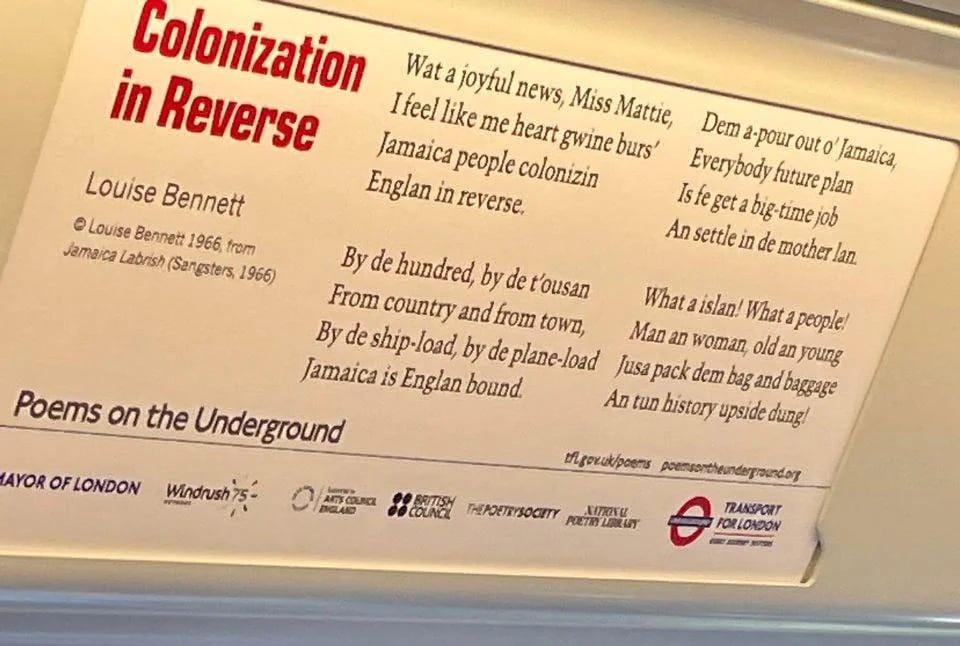
Jamil claimed earlier that her family had to migrate to Britain to follow their stolen wealth, but the final part of her article is where we see the idea of immigration as payback most clearly — that the “narrative” of immigrants draining our economy has “less of a sting” once you know that Britain “invaded THEM on boats … drained THEIR economies first.” I’m sure if pressed she would deny that this narrative of immigrants invading on boats and draining our economy has any truth to it at all, but the fact that she situates immigration in this quid pro quo manner is quite revealing of how she sees things. As I’ve argued above, this argument doesn’t make sense even for the case of Indian immigration to Britain, which is its best theoretical case, considering that Britain did indeed rule India for a long time, and that parts of India did have some significant wealth by premodern standards. It makes even less sense for immigration more widely, which often hails from countries that Britain had far less involvement with, and/or which never had much wealth to begin with. More broadly, considering the the exact dynamics are in place in countries like Ireland, Sweden and Austria, modern immigration clearly has nothing to do with colonial empires at all.
As for the aspects of Britain that Jamil values today, i.e. “what recent generations have made of this mess”, being a Londoner, and our ‘melting pot’, these pretty obviously display the worldview that Britain before its recent age of mass immigration was bad, but that the new Britain defined by immigration and multiculturalism (and, of course, as she mentions elsewhere, our housing benefit system and NHS) is luckily replacing the old version.
I’m not really surprised by her views, and I’m not singling her out as unusually vituperative. In reality she seems to be, as she herself writes, a standard “millennial social justice advocate”, which is why I thought her article was a good example of the common views I am discussing. While these views being held among millennial social justice advocates is one thing, the wider issue is that they are also commonly held among people from India and other parts of the world from which the bulk of our immigration increasingly comes. Witness the popularity of Indian MP Shashi Tharoor’s call for reparations from Britain in 2015, as well as that of his subsequent book An Era of Darkness: The British Empire in India, a bestseller in India, in which he repeats myths such as the East India Company cutting off weavers’ thumbs. Is it really sensible to allow these views to go unchallenged, while also blithely encouraging immigration from parts of the world where they are normalised?
Related articles
On the myth of the British cutting off Indian weavers’ thumbs

I’m currently writing an article which, among other things, touches on the story that the British cut off Indian weavers’ thumbs in order to destroy the Indian textile industry. While this is known to be a myth by historians, or more precisely, a distortion of an original account in the service of a different and much broader conclusion, it’s
Folk Beliefs of the Upper Normie III: “Europe was a Backwater Before Colonialism”

This article is the third in a series on modern folk beliefs. In the series so far:
Modern Folk Beliefs VII: “Immigration built Britain”

This article is the seventh in a series on modern folk beliefs. In the series so far:
I don't know how you had the patience to write this. Faced with the tendentiousness of Jamil's view of colonial history, and the assumption that she is probably impervious to counter-arguments, I'd have been inclined just to throw up my hands and give up. I'm pleased though that you didn't as this can act as a resource.
This is outstanding.