

I’m currently writing an article which, among other things, touches on the story that the British cut off Indian weavers’ thumbs in order to destroy the Indian textile industry. While this is known to be a myth by historians, or more precisely, a distortion of an original account in the service of a different and much broader conclusion, it’s widely believed in India, and to some extent in Britain too. Any serious book on Indian history will describe it as such, however, there’s nothing accessible online that clearly and concisely describes its origin and development, hence this short article. My aim here is to focus on this specific myth; the wider question of the overall British impact on India is for a future one.
The story goes that the British did this in order to eliminate competition for Lancashire textiles, thus enabling them to flood the Indian market, leading to both the enrichment of Britain and the impoverishment of India. The most high-profile recent exponent was Indian MP Shashi Tharoor, who in his speech at an Oxford Union debate in 2015 titled “Britain owes reparations to her former colonies”, claimed that “Britain came right in, smashed their thumbs, broke their looms.” He repeated another version in his bestselling 2017 book Inglorious Empire: What the British did to India, writing that “British imperialism had triumphed not just by conquest and deception on a grand scale but, as I have mentioned, by ruthlessly suppressing dissent, executing rebels and deserters and chopping off the thumbs of skilled weavers so they could not produce the fine cloth that made Britain’s manufactures look tawdry” (Tharoor 2017: 165).
So what’s the source of this story? It originates in Considerations on India Affairs, a book published in 1772 by William Bolts, an ex factor of the East India Company, who had fallen out with the company and was eventually deported from India in 1768. In his excoriating account of the company’s practices Bolts wrote that “the winders of raw silk, called Nagaads, have been treated also with such injustice, that instances have been known of their cutting off their thumbs, to prevent their being forced to wind silk.” (Bolts 1772: 194)
So, Bolts’ account does not in fact allege that the British cut off the thumbs – it alleges that textile workers cut off their own thumbs in order to escape being coerced to work for the company. Bolts is the only source for anything like this; all subsequent accounts derive from him.
It’s true that, once it had gained political power in Bengal, the East India Company abused its position to procure textiles from Indian producers at the cheapest possible price, and coerced them into exploitative contracts. Bolts’ account of the thumb cutting is a response to some of these abusive practices. However, even if it is true, this could have nothing to do with the later decline of the Indian hand textile industry in the face of mechanised British production, because it occurred at least fifty years before British textiles started seriously competing with Indian ones.
Bolts was writing in the 1760s, at which point the East India Company’s business was to acquire textiles from India, not to sell textiles to India. Despite its abuses, the last thing the company would have wanted was to destroy the Indian textile industry, as this was the source of its profits. In fact, the Company was never involved in selling British textiles in India on any significant scale, this occurred later under private traders. Economic historians Broadberry, Custodis and Gupta (2015) find that Indian textile exports to Britain continued to grow until the 1800s, and stayed high until the late 1820s (see table 6 in their paper), while imports from Britain only started to become significant from the mid-1810s (see table 5), once industrialisation had begun to make British textiles cost-competitive with Indian ones.
So how did Bolts’ account get transformed into being a cause of Indian deindustrialisation? It remained relatively obscure in the first decades after its publication, though was occasionally employed in critiques of Britain’s actions in India, such as in abolitionist William Fox’s 1794 pamphlet On the Renewal of the East India Charter. In 1853, Karl Marx published an article The British Rule in India, in which he wrote that “it was the British intruder who broke up the Indian hand-loom and destroyed the spinning-wheel.” Marx was speaking metaphorically, but here we see the origin of the ‘loom breaking’ version of the myth that Tharoor used above, as well as the conflation of violence against textile workers and deindustrialisation.
Bolts’ account took on a new force from the late 19th century with the rise of the Indian nationalist movement, and it was during this period that it became distorted into its modern form. Influential Indian nationalist and economic historian Romesh Chunder Dutt quoted Bolts’ account in his 1902 book The Economic History of India under Early British Rule (p. 27), as did nationalist Lala Lajpat Rai in England’s Debt to India (p. 58). By this point the story had started to become confused, with the narrative often switching to the thumbs being cut off by the British. Gandhi himself commented on this confusion in his Who Cut the Thumbs? (1921), writing in a passage referring to Bolts’ claim, that “speakers mix up facts and say that the Company’s servants cut off the thumbs of artisans.”
Despite Gandhi’s efforts, this new version of the story appears to have become more and more common. In 1922 Charles Yate MP complained in the House of Commons that the fiscal commission in India had been listening to claims of Indian weavers’ thumbs being deliberately chopped off. In an Indian Legislative Assembly debate of the 31st March 1930, member for the Bengal European constituency Darcy Lindsay referred to Indian politician KC Neogy having “stated that thumbs were cut in Bengal by the ancestors of Sir Darcy Lindsay”, replying that, going by Bolts’ original account, it was more like Neogy’s ancestors who cut the thumbs (Legislative Assembly Debates: 2692).
By the mid 20th century it seems to have become a widespread belief in India, used to explain its loss of supremacy in textiles to Britain, and more widely to explain its contemporary poverty and Britain’s wealth. It remains popular today, and is even found in some Indian school textbooks. It’s now become an example of ‘fakelore’; often presented as a story passed down through generations, but in reality originating with the transmission chain I described above.
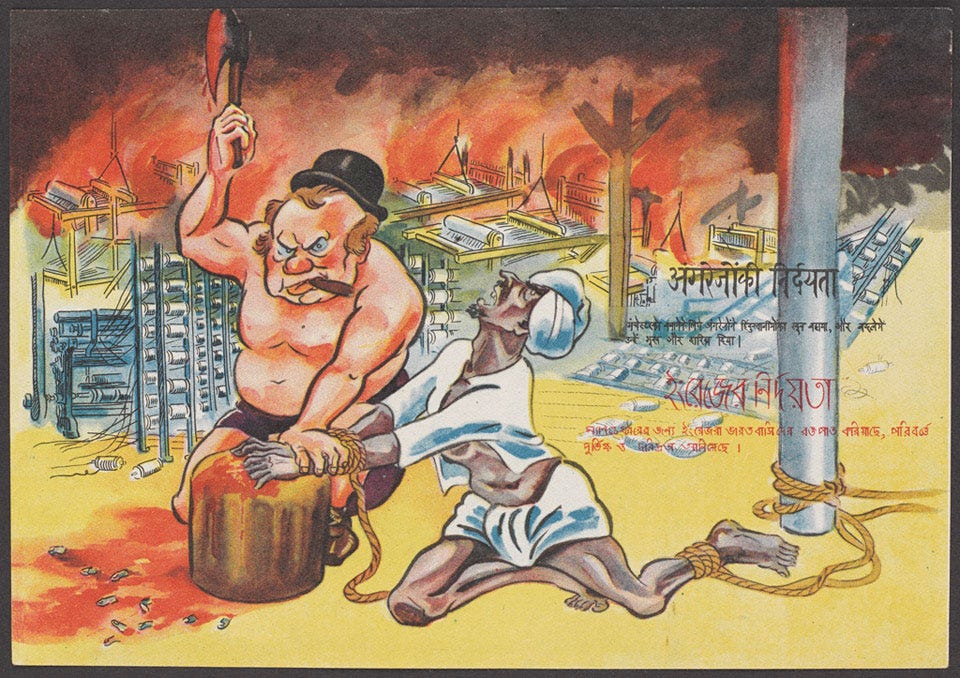
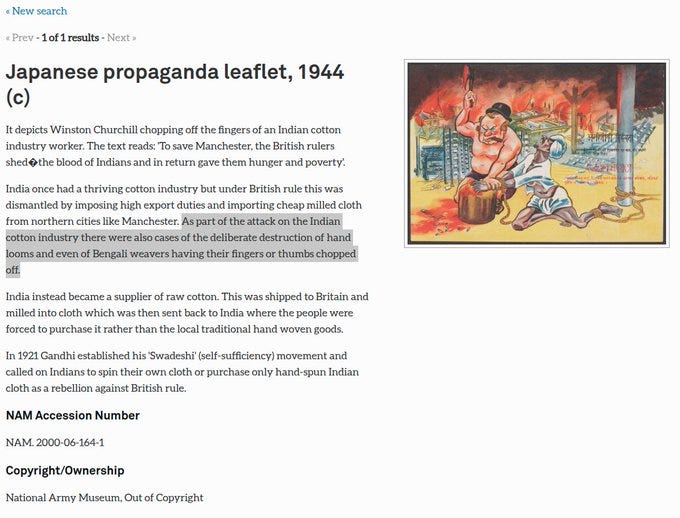
It made its way to Britain too, even before Tharoor’s speech, as in this George Monbiot article from 2009: : “England [...] went on to smash Indian looms and cut off the thumbs of Indian weavers in order to prevent them from making their superior products.” Even the National Army Museum, in their description of a Japanese propaganda leaflet from 1944 depicting Churchill himself doing the chopping, repeat the myth as fact, stating that “[a]s part of the attack on the Indian cotton industry there were also cases of the deliberate destruction of hand looms and even of Bengali weavers having their fingers or thumbs chopped off.” (I emailed them asking them to fix this, which they have said they will do)1
I wonder what William Bolts would think if you could show him the current status of his account, 250 years later.
Sources
Bolts, W. (1772). Considerations on India Affairs.
Broadberry, S., Custodis, J., & Gupta, B. (2015). India and the great divergence: An Anglo-Indian comparison of GDP per capita, 1600–1871. Explorations in Economic History, 55, 58–75.
Dutt, R. C. (1902). The Economic History of India under Early British Rule
Fox, W. (1794). On the Renewal of the East India Charter
Gandhi, M. K. (1921, March 30). Who cut the thumbs? Young India.
Legislative Assembly Debates (Official Report), vol. III, 1930, 31 March 1930, Cotton Textile Industry (Protection) Bill, clause 2, pp. 2690–2713.
Marx, K. (1853, June 25). The British rule in India. New-York Daily Tribune.
Rai, L. L. (1917). England’s Debt to India
Tharoor, S. (2017). Inglorious empire: What the British did to India. Penguin.
UK Parliament, House of Commons. (1922, March 21). India: Fiscal Commission. Hansard.
Related articles
I don’t think this belief quite achieves the status of a ‘modern folk belief’ in Britain (though it does in India). However for more similar articles, see my modern folk beliefs series here. The most relevant one is below.
Folk Beliefs of the Upper Normie III: “Europe was a Backwater Before Colonialism”

This article is the third in a series on modern folk beliefs. In the series so far:
The original NAM page is recorded for posterity below:
As an economist when I encounter narratives of forced “Indian deindustrialisation,” I grit my teeth.
It’s a fiction. I hate these stories that claim “if not for these evil people we would have achieved national greatness!”
The National Army Museum continues to repeat the myth a year later.