

I always enjoy reading the links/roundup posts of writers I like, so I thought I’d do one myself. Below are some links to recent writing I’ve done here and elsewhere, and some books, articles, podcasts and Twitter discourse I’ve found interesting.
I’ve also turned on paid subscriptions to this substack. All posts will remain free to read for now, but if you feel you have too much money and would like to give some to me, and/or would like to support my writing and enable me to write more frequently, I would hugely appreciate it.
Writing
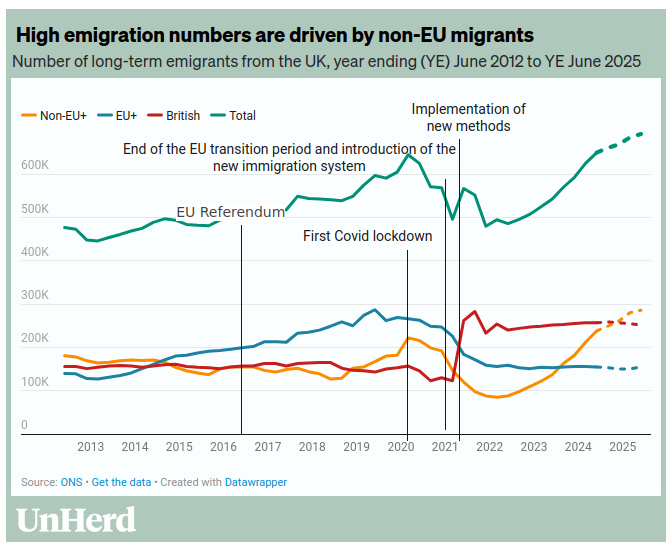
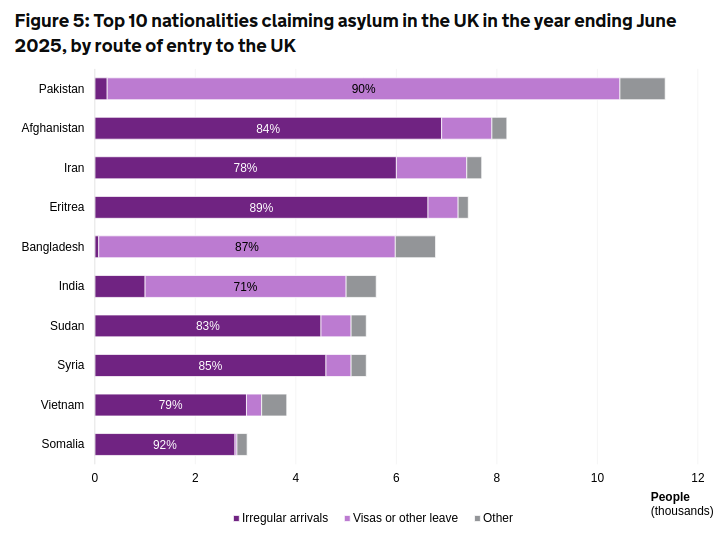
I’ve written for Unherd today about the ONS’s recent release of statistics that led to lots of catastrophising about the idea that they showed an unprecedented number of Brits emigrating. They don’t show this at all, the real story is the continuing massive inflows of people, particularly from South Asia and Africa, and the asylum problem looming ever larger and growing even more absurd (many now arrive on normal visas, then switch).
I published the latest in the modern folk beliefs series on the idea that climate change will lead to human extinction. I’ve decided to broaden the scope of the series from ‘folk beliefs of the upper normie’ given that the holders of some of these beliefs can’t so easily be fitted into this category. And also because I’ve become sick of typing the words ‘upper normie’.
I’m currently working on two more articles for this series. One will be on the somewhat vaguely held belief many people have that family structures and the position of women were the same everywhere in history — provisional title “modern folk belief: your grandmother had kids in her teens”. The other will be on the idea of of anti-essentialism, i.e. the intellectual trend dominant since the early 20th century associated with the blank slate view of human nature. I also might do a followup to “Europe was a backwater before colonialism” looking at the myth that the West’s wealth today comes from slavery and colonialism.
Books
For the family structures article I’ve been reading various things including Alan Macfarlane’s Marriage and Love in England, Emmanuel Todd’s The Explanation of Ideology: Family Structures and Social Systems, and Arland Thornton’s Reading History Sideways. And on essentialism, Carl Degler’s In Search of Human Nature. And as for other books…
Zero to One (Peter Thiel)
I re-read this for my book club – it remains a fantastic book and a more clear-eyed guide to startups and venture capital than any other book I’ve encountered, puncturing many of the myths and cargo cult thinking present in the startup world. It’s a bit dated when it comes to China and AI but I think this is forgivable – I’ll probably do a short review soon.
The Enlightened Economy: Britain and the Industrial Revolution 1700 - 1850 (Joel Mokyr)
I’ve had this book for a while — I bought it last year together with Robert Allen’s The British Industrial Revolution in Global Perspective in order to read an ‘ideas’ vs a ‘material’ explanation for the industrial revolution. I only managed to read Allen’s at the time, partly due to the fact that the Mokyr’s is massive at 500 pages long, but after Mokyr’s recent Nobel win, I thought I’d take another look.
I think we’re about five years into a broad-based intellectual shift towards the ‘ideas’ / ‘great men’ explanation vs the ‘material interests’ one for historical events. When I was growing up material interests were what all smart people believed, so it’s been interesting seeing other explanations come back to the fore. These things of course go in cycles of fashion, leading to an overcorrection, and back again.
The Age of Hitler (Alec Ryrie)
I’m reading this for a book club. The idea of Hitler and the Nazis as providing our foundational moral framework is one that has been discussed a lot recently. It seems obviously true to me, and I’m looking forward to reading a proper treatment of it.
Articles
I’ve read a lot of good articles this month but one that stood out was Dan Williams’s Let’s Not Bring Back The Gatekeepers on the social-media enabled end of elite media gatekeeping, and the older linked Richard Hanania one on elites and populism. I don’t agree with all the conclusions of either, but these dynamics have been completely core to politics in all Western countries over the last ten years so it’s always an important topic. Williams is correct that the liberal elites largely have themselves to blame for this. In common with many, I’m continually astonished by how the growth of what they would call ‘the populist right’ was almost entirely avoidable by them had they merely enacted less insane immigration policies, as, for example, Denmark did.
Podcasts
I’ve been enjoying the new ‘Anon and I’ podcast, especially the episodes with Eggroll Shogun on Japan, CJ on British social housing, and Jew and a Half Men on ‘The State of Jews’. A couple of the guests on other episodes appeared to be literally insane, which was also entertaining.
The Works in Progress episode “The economics of the baby bust” with Jesús Fernández-Villaverde was very good — I didn’t expect a discussion on the fertility crisis to make me laugh so much, but it did, as well as providing some incredible statistics such as the fertility rate of Mexico now being lower than non-Hispanic white Americans, at least according to the work Fernández-Villaverde. This is something that would have been unthinkable a few decades ago, and I think highbrow discussion of this topic is still mostly restricted to rationalist pronatalists. The mainstream educated classes are still stuck in 20th century fears of overpopulation, or ‘we shouldn’t have kids anyway because the immigrants will replenish us’.
Years ago I read Eric Kaufmann’s Shall the Religious Inherit the Earth? which argued, the future will be dominated by the offspring of the very religious. I would say that in addition to the very religious, it is unusual people of other types who will be the first to escape the fertility crisis. Strange, welfare hacking single mothers as in the case of Thea Jaffe; the very wealthy; and possibly, rationalist pronatalists. All groups who have some immunity to the fertility shredding effects of the modern world whereby everyone can see, via Instagram and TikTok, the sort of urban, consumerist lifestyle one can achieve by eschewing children.
Twitter’s most notable recent current thing – women doing PhDs
I always enjoy watching the rise and fall of Twitter’s current thing over the cycle of a few days to a week. The most notable recent one was Ally Louks mark 2 in the form of Juliet Turner, the PhD biologist who was attacked by various of the most moronic manosphere accounts, and as with Ally Louks, gained general sympathy and a massively increased profile as a result. This time things were even more absurd given that this PhD thesis couldn’t even be conceived of as woke or frivolous, unless you think that any sort of non-directly applicable research is frivolous. Furthermore its subject of The Evolution of Cooperation and Division of Labour in Insects, is one that, at least in theory, is relevant to a right-wing view of the world given its relations to sociobiology. E. O. Wilson, the founder of sociobiology, who was attacked in the sociobiology wars in the 70s by people like Stephen Jay Gould and Richard Lewontin for attempting to integrate biology into the study of human behaviour, did his own PhD on ants.
A similar sort of post you see pop up all the time is some variation on “Men don’t care if you’ve a PhD / girlboss, they’d rather marry a hot waitress who’s sweet and bakes cookies”. While as with most manosphere context, there is a grain of truth here (men aren’t really very attracted to women’s education/career achievement per se), overall it’s a completely false impression of how relationship formation among educated professionals actually happens. Educated professional men care a lot about things that are correlated with educational / career achievement such as intelligence and having interests. These men are, in practice even if not in theory, also incredibly sensitive to class and educational background when choosing a long-term partner. From people I know in my own life for example it’s very common for men to marry someone from a completely different ethnic or cultural background but with a similar educational background. But it’s almost unheard of for them to marry a British woman from a drastically different class/educational background.
I think Cartoons Hate Her’s The Gender Wars are Class Wars remains the best explanation of this dynamic, in that a certain subset of lower class men attracted to this sort of content have no idea how relationships among educated professionals work. A guy whose current dating pool is waitresses thinks “if I became rich and successful, that means I can marry the hottest waitress.” I think another part of the explanation might be that while women are comfortable saying things like “I want an educated man” it sounds a bit embarrassing as a man to say that, when according to manosphere discourse you’re supposed to be laser focused on markers of fertility and cookie-baking ability to the exclusion of everything else.
Are the ultra rich immune from fertility trends?
The median number of kids of the 20 richest men in the world is 3 with a mean of 3.75 (mainly Musk).