

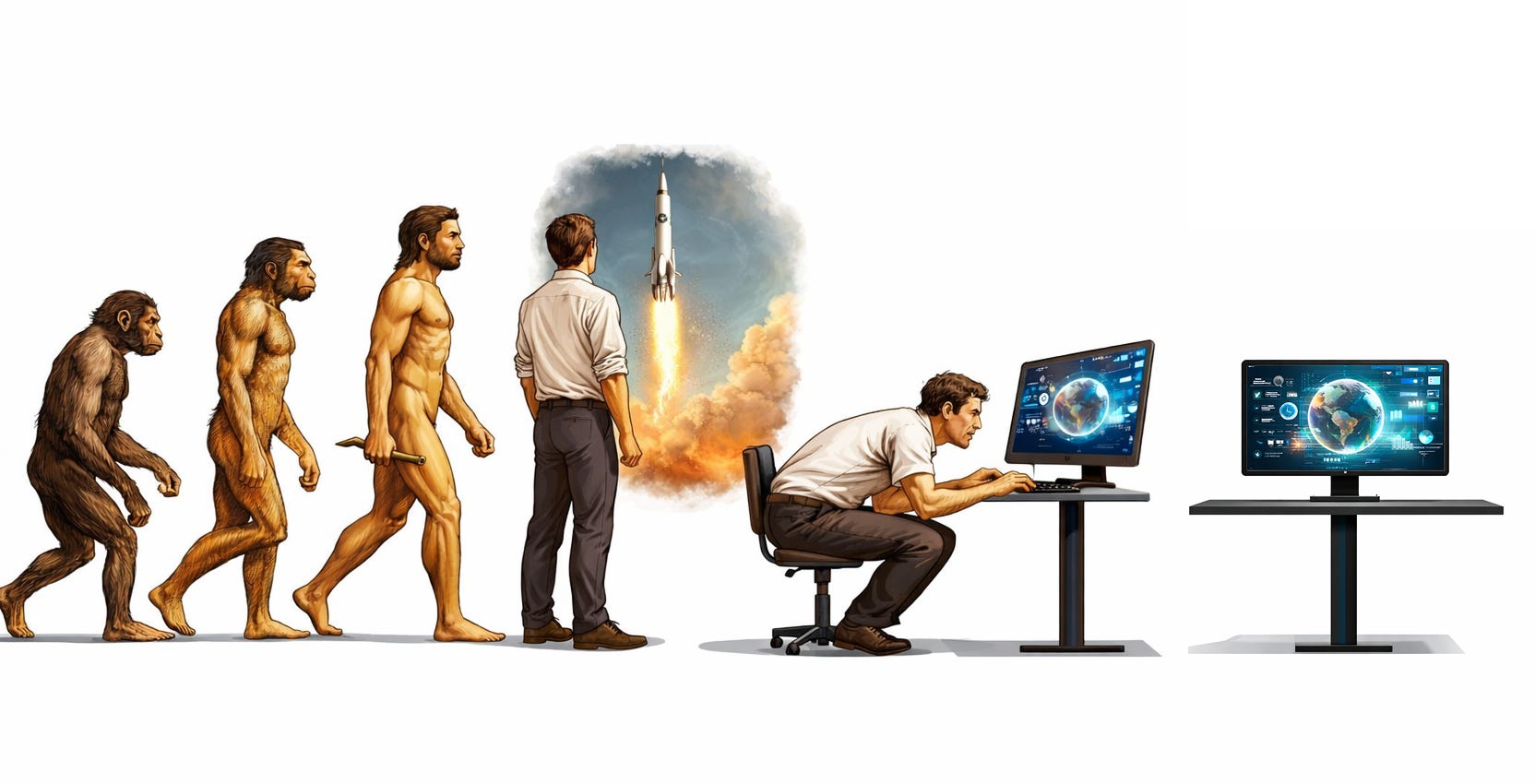
Like many people, I’ve had to update my view of AI capabilities over the last few months. Before late 2025, while I had been using LLMs increasingly (mostly Claude for coding, and ChatGPT and Gemini for basic research) I felt that they couldn’t really be trusted to do more than spit out something plausible-sounding, which might or might not actually work, or be true. In the last few months though, things have changed. Claude frequently gets code right the first time, and when it doesn’t, it’s able to correct its mistakes after a few iterations. Using ChatGPT or Gemini for information produces far fewer hallucinations – I still see them sometimes but it’s now at the stage where I generally feel I can trust their output.
Responses to Matt Shumer’s recent viral Something Big is Happening post ranged from enthusiastic agreement to scorning it for being an obvious hype-marketing ploy. The thing is, it is a hype-marketing ploy, but it is also substantially true. ‘LLMs are just stochastic parrots’ may have been persuasive in 2024 but it sounds absurd to someone who’s used Claude or Codex to do software engineering work in 2026. Whether or not we are in an AI-driven stock market bubble is irrelevant: as with the dot-com bubble of the late 90s, its bursting would do little to head off the progress of the technology. Some make an analogy to the smoke and mirrors, grift-filled cryptomania of 2020-2022, saying AI is just the same. But this is just surface level pattern matching without any understanding of the fundamentals. Yes, people hyped crypto in these years just as they are hyping AI now, but no one looking at the actual technology could think that AI is mostly just hype as crypto was.
I share the view that AI is the most important technology humanity has ever developed. But while I find it incredibly impressive, I don’t feel good about AI – at best it evokes ‘wow that’s useful’ and at worst it evokes the prospect of complete human disempowerment, or worse. And I am hardly alone – has there ever been a technological advance that has made people as sad as AI has, even including its creators? Sam Altman tweeted recently that he “felt a little useless and it was sad” when using Codex, while Dario Amodei continually warns about the existential dangers of what he is building.
For all AI’s current achievement and future promise, where we are now doesn’t really feel like the technological future we were expecting. I think that this is because that vision of the future is still determined by the 20th-century idea of progress, of things like fast cars and space travel. AI is unlike anything else we’ve ever invented, but if we are looking for an analogy, it would be something like cotton spinning.
The 20th-century idea of progress
The 20th century produced a highly appealing form of progress that is still with us today. The most exciting aspect was a ‘bigger, faster, stronger’ vision where humans were empowered to continually go faster and further than ever before. Faster and more powerful cars, bullet trains and supersonic planes, nuclear power, space rockets and the moon landings. A complement to this was the automation of physical drudgery, with the spread of things like vacuum cleaner, washing machine, dishwasher, gas and electric oven, and microwave.
‘Bigger, faster, stronger’ stagnated from the 1970s and 80s. Cars stopped getting faster and lost the space-age styling they had had, at least in the US, in the 1960s. Airliners topped out at a cruising speed of around 550 mph, while Concorde, over twice as fast, remained a niche service and was retired in 2003. High-speed rail technology, despite its recent spread in China, has not changed substantially since it became widespread in Japan and France in the 1980s. Culturally the ideal of speed has receded. As a child I remember the Thrust series of jet-powered cars that held the land speed record being a big deal; the record has not been broken since 1997. The airspeed record has stayed unchanged since 1976, set by the Lockheed SR-71 Blackbird. The world’s most nuclear-reliant country, France, built its power infrastructure in the 1980s; since then Italy and Germany have phased out their own nuclear power network, and Taiwan is soon to follow. Appliances that automate physical drudgery have also not seen much change since the 1970s, except perhaps industrial robots.
Even in China, a place that lacks the regulatory constraints that have made grand infrastructural improvements more difficult in Western countries, the achievement is mostly one of building at speed and scale, rather than pushing the envelope. Electric cars are one partial exception that make it feel genuinely futuristic, as I previously wrote about, but these are a 100-year-old technology, revived in the service of energy independence and the environment. This of course may change now that China has reached the technological frontier, but we haven’t seen it yet.
There are many reasons behind this stagnation which I won’t go into detail about here. One cause is increasing regulation and risk aversion in Western countries. Another is the end of cheap oil after 1974. There is also the fact that the key technologies driving the age of speed were the internal combustion engine, the jet engine, and the rocket engine, which started to hit diminishing returns in the decades after WW2.
This technological stagnation led to a decades-long hangover of disappointment; many people weren’t willing to let the 20th-century vision of the future go. J. Storrs Hall asked “Where’s my flying car”, while Peter Thiel complained “We wanted flying cars, instead we got 140 characters.” Personally I think the idea of post 1970s technological stagnation is overblown. Computing and the internet clearly were transformational, while medical advances, which are even more unsung, have been life-saving and life-changing. Cancer survival rates have hugely improved since the 1970s, and various hugely life limiting conditions such as cystic fibrosis can now effectively be cured, or at least managed.
However, these changes didn’t feel as transformational as previous ones because they didn’t fit the ‘bigger, faster, stronger’ paradigm that people were expecting. While the internet was a bigger, faster, stronger information and communications system than came before, you couldn’t feel that on an emotional level like you could when pushing the speed limit on a new motorway or watching the rumble and fire of a space launch.
The special emotional pull of 20th-century progress is, incidentally, the reason why I think that Elon Musk was, until he started getting involved in politics, so widely admired. Musk kept the flame of 20th-century technological progress alive with space rockets and cars, two of its most emblematic examples. While he clearly does have a genuine interest in these areas, I also think it’s important that Musk, with his talent for publicity and marketing, knew that that’s what would get people excited. However, even his efforts are perhaps more innovative in a 21st century way than a 20th century one. Teslas have great acceleration, but the electric drivetrain enabling this is a 100-year-old technology that lost out to petrol engines at the time. Instead, it’s self-driving technology that is truly new. And while SpaceX’s reusable rockets are genuinely incredible, using them for Mars colonisation was always just a marketing ploy. The major economic incentive for cheaper space launches is to put more satellites in space, so that ultimately you can scroll TikTok even when on flights, cruise ships, or while climbing Everest.
There have been increasing efforts over the last decade to try and get us back on track to 20th-century progress. Some examples are the philosophy of Peter Thiel’s Founders Fund, Marc Andreessen’s It’s Time to Build, the renewed push for nuclear power, YIMBYism and the Abundance movement. In the physical world, there are startups developing new supersonic jets and nuclear fusion. These efforts have had some success, but clearly we have not yet revived the dynamic of the 1960s: in the West, the regulatory state remains restrictive.
Automated cotton spinning is real technological progress
AI feels in line with the type of technological progress since the 1980s, i.e. software and communications. While people paint visions of the acceleration in more physical, 20th-century sorts of progress that AI will enable, these effects have not been seen yet. My perception is that AI does not feel wondrous except to those who want to ‘build’ in the, for now, relatively narrow way that it enables. Personally, I am fully aware of the astonishing nature of the technology, but even so I have to consciously think about how it is a machine doing all this stuff, otherwise I forget and take it all for granted.
Most people don’t think about AI much at all, even if they have started to heavily rely on it. Others worry mostly about its impact on their white-collar jobs, or feel that AI is automating the parts of their life that they want to do, like creating art or writing, and not those they do not, such as cleaning or laundry.
I think the idea of the 20th-century idea of progress was an anomaly. Many of the most impressive examples of this were not actually all that economically impactful, such as Concorde or the Apollo program. I love high speed rail, but many lines do not make economic sense, as China is finding out today. Even the ‘physical drudgery’ automating appliances of the 20th century were unlike what AI is doing today, as they automated only the lowest skilled and least desirable forms of human labour.
The most transformational technological progress in the past was actually much closer to what AI is doing now. This involved automating things that skilled workers could already do, enabling them to be done far faster and more cheaply. Automated cotton spinning and weaving, the wonder industries of the first industrial revolution, worked like this. Early cotton mills certainly attracted a lot of interested observers, but they hardly evoked the quasi-spiritual wonder of seeing a Saturn V rocket taking off. And there were more people, like hand spinners and weavers, violently opposed to them than there were industrialists and their supporters that supported them.
Nevertheless, automated cotton production, and the subsequent automation of other handicrafts, utterly transformed society, by replacing skilled labour and making its output a commodity, making manufactured goods cheaply available to everyone. Initially, automated cotton spinning increased demand for handloom weavers due to all the cheap yarn available, but ultimately weaving was automated too. For now, AI is increasing the productivity of software engineers, without making them redundant, though as with the handloom weavers, I don’t expect this ‘centaur model’ of human-AI collaboration to last very long, at least in its current form. Even with the current level of technology, it’s easy to see how much it could achieve on its own once it’s fully integrated into the software engineering lifecycle.
All that is to say, AI is further proof that the 20th-century, Star Trek future is not really what technological progress is. Technological progress has no necessary connection at all with human empowerment, it just enables us, in Peter Thiel’s words, to do more with less, or perhaps going forward, for more to be done with less. It’s going to be a disconcerting next few years.
Related articles:
Notes on China’s alternative modernity

I recently spent some time in China, visiting Chongqing, Guangzhou, Shenzhen, Hong Kong and Macau. There’s lots of interesting things I could say about this trip, but in this article I’m going to focus specifically on the unique sense of ‘alternative modernity’ you get when travelling in China, from things like the cities, cars, trains, and the way phon…
Folk Beliefs of the Upper Normie III: “Europe was a Backwater Before Colonialism”

This article is the third in a series on modern folk beliefs. In the series so far:
For the equivalent of space rocket images, how about de Loutherbourg's 'Coalbrookdale by Night'? Cotton mills, perhaps less glamorous..
Have you read John Wyndham's The Venus Adventure written in 1932? It predicts a future where pregnancy is replaced with incubators centuries before we reach the moon. Obviously very wrong.